Category: Featured

U.S. Inflation Rate

  • June 13th, 2022

U.S. inflation rate, as measured by consumer price index rose by 1.0 percent in May, as the year-over-year change accelerated to 8.6 percent, the highest level since December 1981. Price increases were mainly driven by shelter, gasoline and food.  Core CPI, which excludes food and energy rose 0.6 percent in May for an annual rate of 6.0 percent.

For a complete report go to:  https://www.bls.gov/news.release/pdf/cpi.pdf

U.S. Economy Posts Solid Jobs Growth in May

  • June 6th, 2022

Total nonfarm payroll employment rose by 390,000 in May, according to the U.S. Bureau of Labor Statistics. Notable job gains occurred in leisure and hospitality (84,000), but still down by 1.3 million or 7.9 percent from February 2020; professional and business services (75,000), higher by 821,000 than in February 2020; transportation and warehousing (47,000); construction (36,000); healthcare (28,000); and manufacturing (28,000). Employment in retail trade was down by 61,000 in May.

In May, the unemployment rate was 3.6 percent for the third month in a row, and the number of unemployed persons was unchanged at 6.0 million. Prior to the COVID-19 pandemic in February 2020, the unemployment rate was 3.5 percent with 5.7 million unemployed.

For a complete report go to: https://www.bls.gov/news.release/pdf/empsit.pdf

BEA News: Gross Domestic Product (Second Estimate) and Corporate Profits (Preliminary), First Quarter 2022

  • May 26th, 2022

The U.S. Bureau of Economic Analysis (BEA) has issued the following news release today:

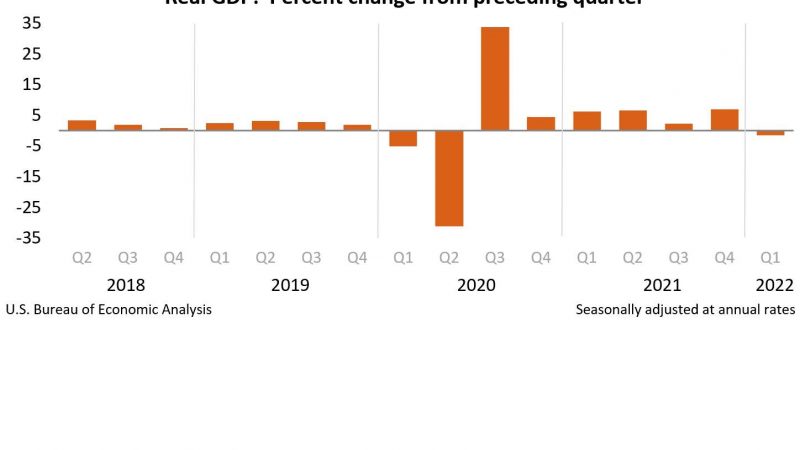
Real gross domestic product (GDP) decreased at an annual rate of 1.5 percent in the first quarter of 2022, following an increase of 6.9 percent in the fourth quarter of 2021. The decrease was revised down 0.1 percentage point from the “advance” estimate released in April. In the first quarter, there was a resurgence of COVID-19 cases from the Omicron variant and decreases in government pandemic assistance payments.

Profits decreased 2.3 percent after increasing 0.7 percent at a quarterly rate in the fourth quarter.

The full text of the release on BEA’s website can be found at: www.bea.gov/news/2022/gross-domestic-product-second-estimate-and-corporate-profits-preliminary-first-quartert

State Business Leaders Uncertain on Short-Term U.S. Economy

  • April 12th, 2022

TUSCALOOSA, Ala. – Even with confidence in the state economy growing along with increasing industry profits and sales, state business leaders are decidedly negative in their outlook for the nation’s economy, according to the latest quarterly survey by The University of Alabama’s Center for Business and Economic Research.

The UA Center for Business and Economic Research’s latest Alabama Business Confidence Index, taken in early March, showed nearly 58% of business leaders forecast worse economic conditions for the United States in the second quarter of 2022.

“Inflation is a big part of the concerns for the U.S. economy,” said Susannah Robichaux, socioeconomic analyst for CBER. “Small and mid-sized firms had notably lower U.S. economic outlooks than large firms, which makes sense since these smaller businesses have tighter margins and would feel the impact of inflation sooner than their larger counterparts.”

The Alabama Business Confidence Index was 54.6, meaning state business leaders have mostly positive economic expectations for their businesses and the state economy in the upcoming quarter, however the latest survey continues the downward trend. An index over 50 indicates a positive forecast compared to the previous quarter, and the higher the number, the more confident the forecast.

The ABCI dropped 2.6 points from the last survey and is down from 67 in a survey taken in June 2021, just before a resurgence of the coronavirus through the Delta variant.

ABCI is gathered from a broad group of business executives across the state with six key indicators and a composite index. The statewide and national forecasts, along with industry-specific components like sales, profits, hiring and capital expenditures comprise the six indexes that combine to make the ABCI total.

While panelists have an overall positive outlook on the economy, nationally, business leaders aren’t as optimistic, reflected in an index of 38.5 for the national economy. In fact, state business leaders have not had a positive outlook for the U.S. economy since that survey snapshot before Delta.

“On one hand we have a relatively strong economy with very strong labor markets, both in terms of hiring and new job creation, labor force participation rate continues to tick upwards, corporate profits look great, and housing markets are doing well,” said Ahmad Ijaz, CEBR executive director. “But there are also signs pointing to the fact that the economy may be headed for a recession.”

Ijaz listed higher prices, falling exports, soaring inflation, rising interest rates, long-term interest rates currently lower than short-term rates, and the continued effects of Russia’s war in Ukraine.

Earlier this year, Ijaz and economists at CBER had predicted Alabama’s economy would grow about 3% in 2022, but have since revised that outlook to 2.7% growth.

Six of the nine industry groups surveyed remain positive in their outlook for the second quarter, with healthcare and social assistance businesses reporting the lowest negative outlook.

The breakdown of all the industry forecasts by sector can be seen in the statewide ABCI report on CBER’s website.

In addition to the statewide ABCI report, CBER also collects ABCI data to write individual reports for Alabama’s five major metro areas. These metro reports offer insight into the forecasts for each specific region.


Source: Susannah Robichaux, socioeconomic analyst for CBER, scrobichaux@cba.ua.edu

Press Release by Adam Jones, UA communications, 205-348-4328, adam.jones@ua.edu

State Economy to Grow in 2022; Pandemic Pitfalls Remain

  • February 3rd, 2022
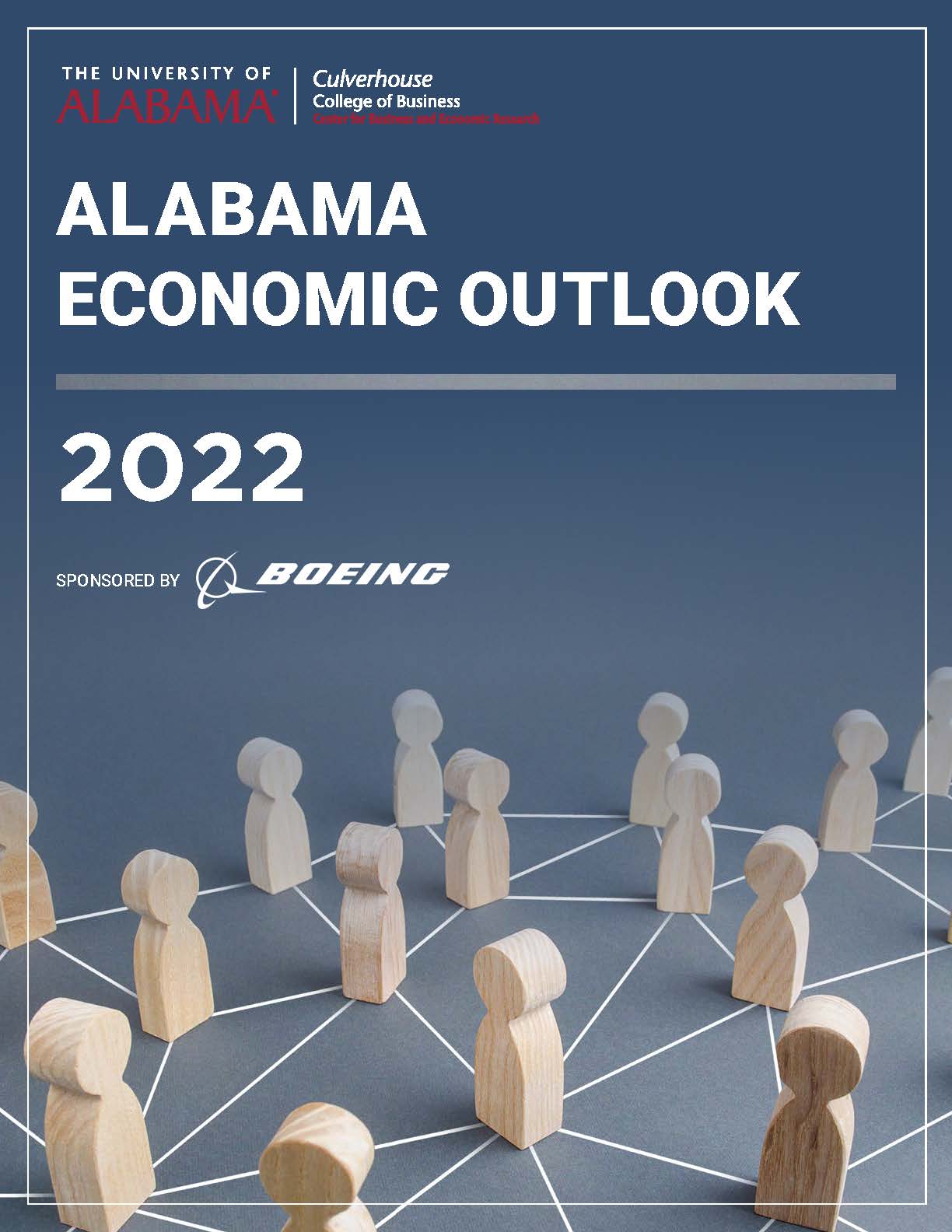
The cover of a the "Alabama Economic Outlook" 2022.

TUSCALOOSA, Ala. – Alabama’s economy could see stellar growth in 2022 as the state and country continue reopening commerce in the wake of the global coronavirus pandemic, according to researchers at The University of Alabama.

Pitfalls remain with the unknown behavior of the virus and continued pandemic-related supply chain bottlenecks, labor shortages and rising prices. Still, low unemployment across Alabama coupled with increased output by the state’s manufacturing and service sectors should mean a rise in the value of goods and services produced in the state, according to the annual economic forecast from the Center for Business and Economic Research at UA.

UA economists predict the state’s economy will grow 3.4% to reach $213.5 billion in Alabama’s gross domestic product. This follows the 4.8% growth in 2021 that shook off the 3.2% economic contraction of 2020, In the previous five years, economic growth in Alabama was never more than 1.7%.

“A 3.4% growth rate is great, considering the growth rate in the years before 2021,” said Ahmad Ijaz, executive director of the center. “It’s likely we will revise this upward, depending on how the data comes in from the fourth quarter of 2021 and the first quarter of 2022.”

Part of the Culverhouse College of Business, UA’s Center for Business and Economic Research has produced forecasts of economic activity in Alabama since 1980. These forecasts cover Alabama’s Gross Domestic Product, employment, and income by industry group and are published in the annual Alabama Economic Outlook. Forecast updates are run quarterly. The center incorporates data from the last 30 years, including cycles and recoveries captured over the years, into its statistical and economic models.

Along with annual dives into the national and state economy, including examinations of metro areas in Alabama, this year’s outlook includes a special look at the 2020 Census and populations changes in the state, authored by Dr. Nyesha Black, director of socioeconomic analysis and demographics.

The 2022 Alabama Economic Outlook, available for free on the center’s website, reports inflation will continue to be an issue this year despite changes in federal monetary policy that will likely see rising interest rates.

“The rate of increase in prices in 2022 may slow down some, but we will still see an increase in price levels in 2022,” Ijaz said. “Hopefully, it won’t be as significant as in 2021, but the changes in prices will continue albeit at a slower pace until the supply side issues and the labor market issues can be resolved.”

Federal efforts the past two years to encourage economic recovery will taper off this year, which will influence demand continuing the trend of the last half of 2021, Ijaz said. Unresolved trade issues, particularly with China, also remain a concern for the state.

For state tax collections, economic growth and yet-to-be-spent federal recovery money will continue the above-average growth. During the fiscal year 2022, total tax receipts are expected to increase by 8.0%, or $1.1 billion above the last fiscal year, to total $15.1 billion.

Source

Ahmad Ijaz, executive director of the UA Center for Business and Economic Research, aijaz@cba.ua.edu

Contact

Adam Jones, UA communications, 205-348-4328, adam.jones@ua.edu

The University of Alabama, part of The University of Alabama System, is the state’s flagship university. UA shapes a better world through its teaching, research and service. With a global reputation for excellence, UA provides an inclusive, forward-thinking environment and nearly 200 degree programs on a beautiful, student-centered campus. A leader in cutting-edge research, UA advances discovery, creative inquiry and knowledge through more than 30 research centers. As the state’s largest higher education institution, UA drives economic growth in Alabama and beyond.


Despite Lingering Pandemic, State Businesses Remain Optimistic

  • October 12th, 2021
TUSCALOOSA, Ala. – While not as confident in the economic outlook as they were earlier this year, state business leaders remain optimistic in growth through year’s end, according to the latest quarterly survey by The University of Alabama.

Confidence in economic growth among state business leaders has been steadily trending upward from the early days of the global pandemic, reaching a historically high confidence in the survey of local business leaders taken in June just before the contagious Delta variant of the coronavirus that causes COVID-19 spread in the region.

The UA Center for Business and Economic Research’s latest Alabama Business Confidence Index, taken in the first half of September, showed business leaders are moderately confident for improving economic conditions in Alabama, but are on the fence about the direction of the United States’ economy.

The latest ABCI was 58, down from 67 in this summer’s report. An index over 50 indicates a positive forecast compared to the previous quarter, and the higher the number, the more confident the forecast. The statewide and national forecasts, along with industry-specific components like sales, profits, hiring and capital expenditures comprise the six indexes that combine to make the ABCI total.

“That is a significant drop, but since it still remains positive, it’s not as significant as if it had crossed the 50 threshold to be a negative forecast,” said Susannah Robichaux, socioeconomic analyst for CBER. “Business leaders were feeling very optimistic last quarter about growth compared to second quarter 2021. Now, they are forecasting a continuation of that positive trajectory but are not feeling quite as confident about that expectation.”

However, business leaders were not as optimistic on the national economic outlook for the last quarter of 2021, compiling a 50.7 confidence index, down 14 points from the index reported this summer. Ahmad Ijaz, CBER executive director, said the expectation for the second half of this year is weaker economic growth than the boom of the first half of 2021, but the third quarter may end up weaker than predicted.

Still, economic growth should pick back up when some global supply issues caused by the pandemic are resolved next year, he said.

“Overall, the economy seems to be doing okay,” Ijaz said. “We are adding more jobs, albeit, at a slower pace, payroll income levels are going up, household wealth is growing, more people are working and entering the labor force, but there is just no way to match the kind of growth rates we saw in the second half of last year or earlier this year.”

Eight of the nine industry groups surveyed remain positive in their outlook for the fourth quarter, with only leaders in the state’s retail trade reporting a negative confidence index.

The industries do report strong expectations for increased hiring compared to the last quarter.

“The very confident hiring index means that we’ll likely see a continuation of businesses rebuilding their workforce and hiring at a high rate next quarter,” Robichaux said.

The breakdown of all the industry forecasts by sector can be seen in the statewide ABCI report on CBER’s website.

In addition to the statewide ABCI report, CBER also collects ABCI data to write individual reports for Alabama’s five major metro areas. These metro reports offer insight into the forecasts for each specific region.

https://news.ua.edu/2021/10/despite-lingering-pandemic-state-businesses-remain-optimistic/

Source:

Susannah Robichaux, socioeconomic analyst, UA’s Center for Business and Economic Research, 205-348-3781, scrobichaux@culverhouse.ua.edu

Contact:
Adam Jones, UA communications, 205-348-4328, adam.jones@ua.edu

The University of Alabama, part of The University of Alabama System, is the state’s flagship university. UA shapes a better world through its teaching, research and service. With a global reputation for excellence, UA provides an inclusive, forward-thinking environment and nearly 200 degree programs on a beautiful, student-centered campus. A leader in cutting-edge research, UA advances discovery, creative inquiry and knowledge through more than 30 research centers. As the state’s largest higher education institution, UA drives economic growth in Alabama and beyond.

Free Fall 2021 Data Conference

  • August 31st, 2021

The Alabama State Data Center (ASDC), housed in the University of Alabama’s Center for Business and Economic Research (CBER) hosted a second Census data conference this fall on Thursday, October 7 from noon to 4:00 p.m. The virtual conference included presentations on how to access the latest 2020 decennial Census results from Data.Census.gov, the innovative Census Pulse Survey, the Count Question Resolution (CQR) program, and the economic products available from the U.S. Census Bureau. Click on the red titles below to view the slide deck from each presentation.

Alabama State Data Center Fall 2021 Conference
Thursday, October 7, 2021: 12:00 – 4:00 p.m.

Welcome and Introductions | Susannah Robichaux, ASDC Lead / Socioeconomic Analyst, The University of Alabama’s Center for Business and Economic Research; and Barb Lafleur, Acting Assistant Branch Chief and State Data Center Liaison, Data Users Branch, U.S. Census Bureau.

Data.Census.Gov | KaNin Reese, Partnership Specialist, Branch Chief, Dissemination Outreach Branch, Center for Enterprise Dissemination, U.S. Census Bureau. This presentation includes step-by-step demos for data.census.gov including topics like getting started using the single search bar or advanced search, comparing data across time and geographies, finding business data (searching by industry), and microdata access (MDAT).

Pulse Survey | Kathryn Bonney, Economic Management Division; Colin Shevlin, Economic Indicators Division; and Jason Fields, Social Economic & Housing Statistics Division, U.S. Census Bureau. An overview of the two Pulse surveys: the Small Business Pulse Survey (SBPS), which measures the effect of changing business conditions during the Coronavirus pandemic on U.S. small businesses, and the Household Pulse Survey (HPS), which was designed to understand the impact of COVID-19 on American families relating to employment, food security, housing, health, and educational disruption.

Count Question Resolution | Matthew Frates, Chief of the Count Question Resolution Branch, Decennial Census Management Division, U.S. Census Bureau. The 2020 Census Count Question Resolution (CQR) program provides a mechanism for governmental units to request a review of their official 2020 Census results and to help ensure that housing and population counts are correctly allocated to 2020 census tabulation blocks. This presentation is not yet available, so the link leads to the official Census CQR page.

An Overview of Key Economic Data for Alabama (including COVID data)| Andrew W. Hait, Economist, International Trade Management Division, U.S. Census Bureau. The U.S. Census Bureau is the federal government’s largest statistical agency and conducts more than 130 censuses and surveys each year. This presentation covers some of the types of data available from the economic surveys, how to access them, and some pre-made searches to help you find Alabama statistics.

Top Issue Facing Alabama: Education and Workforce Training

  • August 31st, 2021

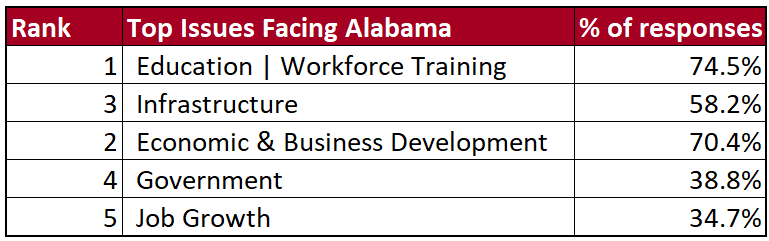
Education and workforce training is the top issue facing Alabama’s economy, according to business leaders who participated in the 2020 Alabama Business Confidence Index (ABCI) Panelist Poll.

Rank of the top issues facing Alabama: education and workforce training is first, infrastucture is second, economic and business development is third, government is fourth, and job growth is fifth. Alabama business leaders have voted education and workforce training as the state’s primary issues for the last five years. In the 2020 survey, 74.5 percent of panelists reported concerns about the state of the education and workforce training system, and 18 percent of those panelists provided specific comments, which included concerns about the lack of funding for education, the shortage of qualified workers, and a desire for more short-term training opportunities for all fields. Panelists ranked economic and business development as a close second at 70.4 percent, and 20.0 percent shared worries about the uncertainty related to COVID-19 and the importance of diversifying the state economy.

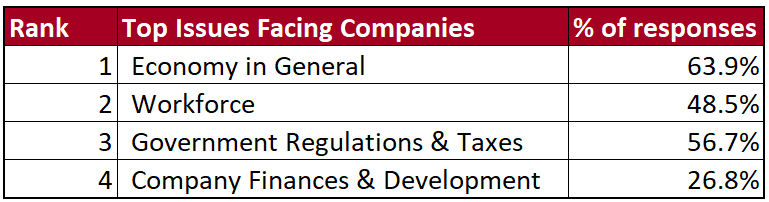
List of the top issues facing Alabama Companies ranked from highest to lowest % votes: economy in general is first, workforce is second, government regulations and taxes is third, and company finances and development is fourth.

Panelists were also able to select the top issues facing their own companies. Though almost half of the business leaders were concerned about workforce issues, 63.9 percent selected the “economy in general” as their number one concern. Among those who selected the economy as one of their top concern, 14.5 percent shared more details about their selection, with many naming the uncertainty due to COVID-19 and 2020 election as their main concerns.

Each quarter, business leaders respond to the ABCI survey and receive reports that summarize the business sentiment for the state and its five largest metro areas. Business leaders use these quarterly reports as a general indicator of local and regional economic outlook (80.6 percent), as background information for their own forecasts (43.9 percent), and to compare their personal projections to their fellow peers in business (35.7 percent). In addition, 28.6 percent of business leaders who responded to the poll use ABCI reports for economic development, decision-making, or short-term planning, and 24.5 percent share the results from ABCI with others.

About the ABCI Panelist Poll
The Center for Business and Economic Research (CBER) in The University of Alabama’s Culverhouse College of Business conducts an annual survey of Alabama business leaders to determine the top issues facing the state and their respective companies. The ABCI panel is open to business executives across the state, and was conducted throughout November 2020.

Registration and current and historical results are available on the ABCI page of CBER’s website. Newsletters with results are provided for Alabama and for the Birmingham-Hoover, Huntsville, Mobile, Montgomery, and Tuscaloosa metro areas. Panelists can take the Q4 2021 survey from September 1-15, 2021. For questions, please contact socioeconomic analyst, Susannah Robichaux at scrobichaux@cba.ua.edu.

State’s Economic Recovery Booming Just Before COVID-19 Resurgence

  • August 10th, 2021

TUSCALOOSA, Ala. – Two snapshots of the state’s economy earlier this summer show recovery from the pandemic recession of 2020 exceeding expectations, with business leaders confident things were getting even better, according to research from The University of Alabama.

It’s unknown whether the rise of the Delta variant of the coronavirus that causes COVID-19 will dampen the economy, but, if it does, nothing short of another lockdown could stunt the recovery, said Ahmad Ijaz, executive director of the UA Center for Business and Economic Research.

“We will most likely see 5.0 to 5.5 percent growth for this year, and perhaps next year too, on the condition that we don’t shut down the economy again,” Ijaz said. “Another shut down will most likely have a much more devastating impact on the economy.”

CBER released its quarterly economic forecast, Alabama Business, today which showed the state’s economy grew 6.8% in the first quarter of 2021, which followed a strong half of 2020 after plummeting economic activity the first half of last year.

The forecasted 5.5% economic growth for 2021 will make up the 2.7% drop in economic activity in 2020.

The state’s economy has continued to beat growth forecasts as business sectors come back at different speeds because of supply constraints and loose monetary policy fueled business and consumer spending, Ijaz said.

“At the start of the year, everybody was predicting that the economy would get back to its normal course after a huge jump in growth in third and fourth quarters of 2020, but as the year went along the economic growth just kept on accelerating,” he said.

The state gained 13,200 jobs in June over the previous three months. From June 2020 to June 2021, the state gained 89,200 jobs with a seasonally adjusted unemployment rate this June of 3.3 percent, down from the 7.7 percent unemployment rate in June 2020, according to the study.

Also, CBER released its latest quarterly survey of local business leaders. Taken in the first half of June, it showed historical confidence about the direction of Alabama’s economy. The Alabama Business Confidence Index was 67, up nearly three points from the spring survey.

It’s the most confidence business leaders have had in forecasting economic growth since the third quarter of 2004, according to CBER data. Plus, this is the third consecutive quarter all the industry-level ABCIs have been positive, indicating sustained expectations for economic expansion across all industries in Alabama.

An index over 50 indicates a positive forecast compared to the previous quarter, and the higher the number, the more confident the forecast. The statewide and national forecasts, along with industry-specific components like sales, profits, hiring and capital expenditures comprise the six indexes that combine to make the ABCI total.

For those participating in the survey, more than three-fourths forecasted a better economic outlook for Alabama in the third quarter of the year, and 70 percent expected sales to increase compared to the second quarter of 2021.

“Alabama business leaders were feeling really good in June,” said Susannah Robichaux, socioeconomic analyst for CBER. “Many businesses throughout the state experienced some contraction and uncertainty due to COVID, and these latest ABCI results tell us that folks were really anticipating a recovery and feeling confident in their forecasts for growth. Now, some of that is up in the air due to the Delta variant making such a strong showing.”

The breakdown of all the industry forecasts by sector can be seen in the statewide ABCI report on CBER’s website.

In addition to the statewide ABCI report, CBER also collects ABCI data to write individual reports for Alabama’s five major metro areas. These metro reports offer insight into the forecasts for each specific region.

Original Source: https://news.ua.edu/2021/08/states-economic-recovery-booming-just-before-covid-19-resurgence/

The University of Alabama, part of The University of Alabama System, is the state’s flagship university. UA shapes a better world through its teaching, research and service. With a global reputation for excellence, UA provides an inclusive, forward-thinking environment and nearly 200 degree programs on a beautiful, student-centered campus. A leader in cutting-edge research, UA advances discovery, creative inquiry and knowledge through more than 30 research centers. As the state’s largest higher education institution, UA drives economic growth in Alabama and beyond.
CBER Hosts Annual Census Data Conference

  • May 17th, 2021

The Alabama State Data Center (ASDC), housed in the University of Alabama’s Center for Business and Economic Research (CBER) hosted it’s annual Census Data Conference on Thursday, May 20, 2021 from 9:00 a.m. to 12:00 p.m. The virtual conference featured speakers from the U.S. Census Bureau who present on a variety of topics including a review of the 2020 census and data release dates, how to access data using data.census.gov, upcoming geography surveys, and making the most of the Census Bureau’s economy and business data. Click on the red titles below to view the slide deck from each presentation.

Alabama State Data Center 2021 Data Conference
Thursday, May 20, 2021: 9:00 a.m. – 12:00 p.m.

Welcome and Introductions | Susannah Robichaux, ASDC Lead / Socioeconomic Analyst, The University of Alabama’s Center for Business and Economic Research

Introduction of Speakers and Overview Interactive Chat Q/A Discussion | Carletta Singleton, Partnership Specialist, Atlanta Regional Census Center, U.S. Census Bureau. Review topics, speakers, and instructions for virtual chat question/answer (Q/A) discussion.

2020 Census Recap & U. S. Census Thank You Campaign | Marilyn Stephens, Partnership Coordinator, Atlanta Regional Census Center, U.S. Census Bureau. This presentation gave a brief overview of the 2020 Census field operations, the Thank You Campaign, and a highlighted timeline for data release.

Overview of New Changes to Census Data Website | KaNin Reese, Chief of the Dissemination Outreach Branch, U.S. Census Bureau Headquarters. This presentation focused on innovative changes to the data.census.gov website, data tools, and content making data easy to discover, access, and analyze. Learn about the changes to the census data site to navigate and maximize your use of Census Data!

2020 Census Geography Updates for Alabama | William Curry, Geographer, U.S. Census Bureau, Atlanta Regional Office. This presentation on 2020 Census Geography highlighted LUCA, BAS and provided data users updates on changes in census geography in Alabama for census tracts, census blocks, census designated places federal and state tribal areas.

Economic and Business Surveys, Economy Census Data Profile | Andrew W. Hait, Survey Statistician / Economist, U.S. Census Bureau, Washington, D C.: This session provided a brief overview of data for Alabama from key Census business programs, including the Economic Census, County Business Patterns, and the Annual Business Survey. The presentation gave tips to data users for incorporating these data with the American Community Survey (ACS) data to better understand the Alabama economy, and how to use key tools such as Census Business Builder and demonstration on the COVID-19 Hub.