Author: scrobichaux

State Business Leaders Still Sour on Economy – Q4 2022 ABCI Results

  • October 25th, 2022

TUSCALOOSA, Ala. – For the second consecutive quarter, state business leaders have a negative outlook on the economy, according to the latest quarterly survey by The University of Alabama.

The UA Center for Business and Economic Research’s latest Alabama Business Confidence Index, taken in early September, remains slightly negative following a similar outlook in the snapshot taken over the summer, the first negative outlook for the economy since early 2013.

“Panelists are still forecasting worse economic conditions in the U.S. with very strong confidence, in contrast with their more positive expectations for growth in industry hiring, sales, and capital expenditures,” said Susannah Robichaux, socioeconomic analyst for CBER.

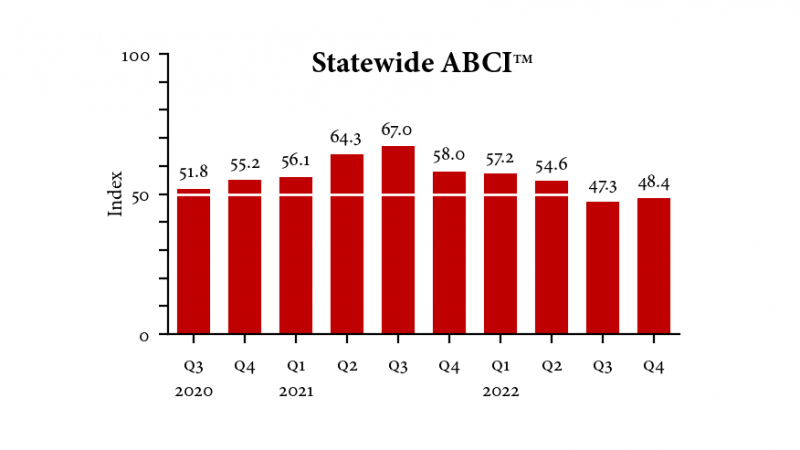
The Alabama Business Confidence Index was 48.4, up slightly from last quarter, and marks the first time the index hasn’t dropped in a year. An index over 50 indicates a positive forecast compared to the previous quarter, and the closer the number is to 100, the more confident the forecast.

ABCI is gathered from a broad group of business executives across the state with six key indicators and a composite index. The statewide and national forecasts, along with industry-specific components like sales, profits, hiring and capital expenditures comprise the six indexes that combine to make the ABCI total.

Panelists continue to be more negative about the U.S. economy than the state’s economy, registering a 34.6 confidence index nationally and a moderately negative 46.3 index for Alabama. Still, those were greater than indices from last quarter.

Earlier this year, CBER economists had predicted Alabama’s economy would grow about 3% in 2022, but have since revised that outlook to 1.8% growth.

The report also breaks down responses from nine industry groups surveyed. The healthcare and social assistance industry, in stark contrast to the last two quarters, had a positive outlook, registering a 50.6 index. In the past two quarters, this industry had the most negative outlook out of all sectors.

“Panelists in the industry are optimistic that they will have increased hiring, sales, and profits, indicating expectations for a rebound from their two quarters of depressed forecasts,” Robichaux said.

Firms of all sizes had mildly negative outlooks for their companies.

“Panelists in large firms are forecasting growth in all of the industry components, while small firms had a negative profits index counteracting their optimism for sales, hiring and capital expenditures,” Robichaux said. “Mid-sized firms are still anticipating increased hiring in the fourth quarter of 2022, but the rest of their component indexes were negative.”

The breakdown of all the industry forecasts by sector can be seen in the statewide ABCI report on CBER’s website.

In addition to the statewide ABCI report, CBER also collects ABCI data to write individual reports for Alabama metro areas. These metro reports offer insight into the forecasts for each specific region. Interestingly, the business leaders in Tuscaloosa are feeling most confident of the three metro areas represented in the latest survey that included Huntsville and Birmingham.

Source: Susannah Robichaux, socioeconomic analyst for CBER, scrobichaux@cba.ua.edu

Press release written by Adam Jones, UA Strategic Communications.
Free 2022 ASDC Fall Data Conference

  • October 10th, 2022

The Alabama State Data Center (ASDC), housed in the University of Alabama’s Center for Business and Economic Research (CBER) hosted a Census data conference this fall on Wednesday, November 9, 2022 from 8:30am to 1:00pm CST. The virtual conference included presentations on the latest updates from Data.Census.gov; the Public Use Microdata Sample (PUMS); how to access PUMS data and make custom tables using the Census Bureau’s MDAT tool; an update on the urban and rural classification; and an overview of local geographic news. The speakers came from the Census headquarters as well as from the regional office in Atlanta.

Click on the red, bold titles below to view the slides for the presentations. For recordings of the webinars, reach out to Susannah Robichaux, CBER socioeconomic analyst and lead for the ASDC, at scrobichaux@ua.edu.

Alabama State Data Center Fall 2022 Conference
Wednesday, November 9, 2022: 8:30am – 1:00pm

Welcome and Introductions | Susannah Robichaux, ASDC Lead / Socioeconomic Analyst, The University of Alabama’s Center for Business and Economic Research; and Devon Reed, Customer Liaison and Marketing Services Office, Data Users Branch, U.S. Census Bureau.

Data.Census.Gov Updates| Kanin Reese, Chief, Dissemination Outreach Branch – Center for Enterprise Dissemination, U.S. Census Bureau. Data.census.gov is the Census Bureau’s primary data search tool. This new platform allows users to spend less time searching for data and content by accessing available data from one centralized place. Since the platform is driven by user feedback, enhancements and upgrades to the tool are being implemented regularly. This webinar featured a how-to training for the tool, an overview if it’s latest functions, and upcoming enhancements and data releases.

Public Use Microdata Sample (PUMS)| Monica Dukes, Alabama Data Dissemination Specialist, Data Dissemination and Training Branch, U.S. Census Bureau. Are you a data user that can’t find what you are looking for in the pre tabulated ACS data products? Then the Public Use Microdata Sample (PUMS) may be what you are looking for. The PUMS files are a set of untabulated records about individual people or housing units, which allow data users to create custom estimates and tables free of charge. This presentation provided an overview of PUMS files and their usage.

Microdata Access Tool (MDAT)| Kanin Reese, U.S. Census Bureau. The Microdata Access Tool (MDAT), available through data.census.gov, allows users to create custom tabulations with various available Public Use Microdata sets and vintages. This webinar covered the basics of using the MDAT tool, including how to access microdata, and a demonstration on how to access data, and create custom tabulations, for topics like sex, age, race and ethnicity, income and poverty, and more.

Urban and Rural Classification and Criteria | B. Rush White, Geographer, Geography Division, U.S. Census Bureau. This webinar offered a review of the 2010 Urban and Rural classifications as well as the 2020 criteria by discussing changes in approaches to interpreting and understanding the growth of urban areas, improved technology making it easier to manage large amounts of data, and increased spatial resolution of statistical and geospatial data.

Geographic Partnership Updates | William Curry, Geographer, Atlanta Regional Census Center/Field Division, U.S. Census Bureau. *No slides were used.* This presentation touched on the various geographic updates using these helpful flyers: Count Question Resolution Program, 2020 Post Census Group Quarters Review, and 2023 Boundary and Annexation Survey.

State Business Leaders Uncertain on Short-Term U.S. Economy

  • April 12th, 2022

TUSCALOOSA, Ala. – Even with confidence in the state economy growing along with increasing industry profits and sales, state business leaders are decidedly negative in their outlook for the nation’s economy, according to the latest quarterly survey by The University of Alabama’s Center for Business and Economic Research.

The UA Center for Business and Economic Research’s latest Alabama Business Confidence Index, taken in early March, showed nearly 58% of business leaders forecast worse economic conditions for the United States in the second quarter of 2022.

“Inflation is a big part of the concerns for the U.S. economy,” said Susannah Robichaux, socioeconomic analyst for CBER. “Small and mid-sized firms had notably lower U.S. economic outlooks than large firms, which makes sense since these smaller businesses have tighter margins and would feel the impact of inflation sooner than their larger counterparts.”

The Alabama Business Confidence Index was 54.6, meaning state business leaders have mostly positive economic expectations for their businesses and the state economy in the upcoming quarter, however the latest survey continues the downward trend. An index over 50 indicates a positive forecast compared to the previous quarter, and the higher the number, the more confident the forecast.

The ABCI dropped 2.6 points from the last survey and is down from 67 in a survey taken in June 2021, just before a resurgence of the coronavirus through the Delta variant.

ABCI is gathered from a broad group of business executives across the state with six key indicators and a composite index. The statewide and national forecasts, along with industry-specific components like sales, profits, hiring and capital expenditures comprise the six indexes that combine to make the ABCI total.

While panelists have an overall positive outlook on the economy, nationally, business leaders aren’t as optimistic, reflected in an index of 38.5 for the national economy. In fact, state business leaders have not had a positive outlook for the U.S. economy since that survey snapshot before Delta.

“On one hand we have a relatively strong economy with very strong labor markets, both in terms of hiring and new job creation, labor force participation rate continues to tick upwards, corporate profits look great, and housing markets are doing well,” said Ahmad Ijaz, CEBR executive director. “But there are also signs pointing to the fact that the economy may be headed for a recession.”

Ijaz listed higher prices, falling exports, soaring inflation, rising interest rates, long-term interest rates currently lower than short-term rates, and the continued effects of Russia’s war in Ukraine.

Earlier this year, Ijaz and economists at CBER had predicted Alabama’s economy would grow about 3% in 2022, but have since revised that outlook to 2.7% growth.

Six of the nine industry groups surveyed remain positive in their outlook for the second quarter, with healthcare and social assistance businesses reporting the lowest negative outlook.

The breakdown of all the industry forecasts by sector can be seen in the statewide ABCI report on CBER’s website.

In addition to the statewide ABCI report, CBER also collects ABCI data to write individual reports for Alabama’s five major metro areas. These metro reports offer insight into the forecasts for each specific region.


Source: Susannah Robichaux, socioeconomic analyst for CBER, scrobichaux@cba.ua.edu

Press Release by Adam Jones, UA communications, 205-348-4328, adam.jones@ua.edu

Free Fall 2021 Data Conference

  • August 31st, 2021

The Alabama State Data Center (ASDC), housed in the University of Alabama’s Center for Business and Economic Research (CBER) hosted a second Census data conference this fall on Thursday, October 7 from noon to 4:00 p.m. The virtual conference included presentations on how to access the latest 2020 decennial Census results from Data.Census.gov, the innovative Census Pulse Survey, the Count Question Resolution (CQR) program, and the economic products available from the U.S. Census Bureau. Click on the red titles below to view the slide deck from each presentation.

Alabama State Data Center Fall 2021 Conference
Thursday, October 7, 2021: 12:00 – 4:00 p.m.

Welcome and Introductions | Susannah Robichaux, ASDC Lead / Socioeconomic Analyst, The University of Alabama’s Center for Business and Economic Research; and Barb Lafleur, Acting Assistant Branch Chief and State Data Center Liaison, Data Users Branch, U.S. Census Bureau.

Data.Census.Gov | KaNin Reese, Partnership Specialist, Branch Chief, Dissemination Outreach Branch, Center for Enterprise Dissemination, U.S. Census Bureau. This presentation includes step-by-step demos for data.census.gov including topics like getting started using the single search bar or advanced search, comparing data across time and geographies, finding business data (searching by industry), and microdata access (MDAT).

Pulse Survey | Kathryn Bonney, Economic Management Division; Colin Shevlin, Economic Indicators Division; and Jason Fields, Social Economic & Housing Statistics Division, U.S. Census Bureau. An overview of the two Pulse surveys: the Small Business Pulse Survey (SBPS), which measures the effect of changing business conditions during the Coronavirus pandemic on U.S. small businesses, and the Household Pulse Survey (HPS), which was designed to understand the impact of COVID-19 on American families relating to employment, food security, housing, health, and educational disruption.

Count Question Resolution | Matthew Frates, Chief of the Count Question Resolution Branch, Decennial Census Management Division, U.S. Census Bureau. The 2020 Census Count Question Resolution (CQR) program provides a mechanism for governmental units to request a review of their official 2020 Census results and to help ensure that housing and population counts are correctly allocated to 2020 census tabulation blocks. This presentation is not yet available, so the link leads to the official Census CQR page.

An Overview of Key Economic Data for Alabama (including COVID data)| Andrew W. Hait, Economist, International Trade Management Division, U.S. Census Bureau. The U.S. Census Bureau is the federal government’s largest statistical agency and conducts more than 130 censuses and surveys each year. This presentation covers some of the types of data available from the economic surveys, how to access them, and some pre-made searches to help you find Alabama statistics.

Top Issue Facing Alabama: Education and Workforce Training

  • August 31st, 2021

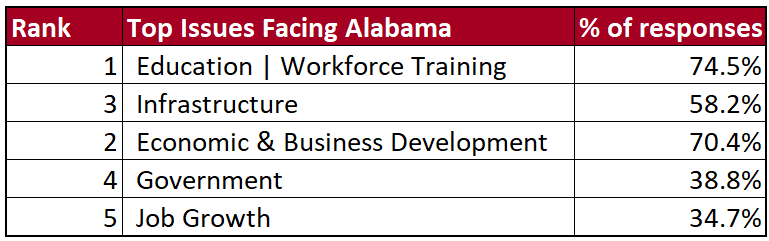
Education and workforce training is the top issue facing Alabama’s economy, according to business leaders who participated in the 2020 Alabama Business Confidence Index (ABCI) Panelist Poll.

Rank of the top issues facing Alabama: education and workforce training is first, infrastucture is second, economic and business development is third, government is fourth, and job growth is fifth. Alabama business leaders have voted education and workforce training as the state’s primary issues for the last five years. In the 2020 survey, 74.5 percent of panelists reported concerns about the state of the education and workforce training system, and 18 percent of those panelists provided specific comments, which included concerns about the lack of funding for education, the shortage of qualified workers, and a desire for more short-term training opportunities for all fields. Panelists ranked economic and business development as a close second at 70.4 percent, and 20.0 percent shared worries about the uncertainty related to COVID-19 and the importance of diversifying the state economy.
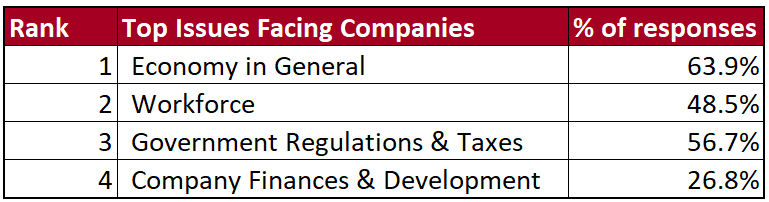

List of the top issues facing Alabama Companies ranked from highest to lowest % votes: economy in general is first, workforce is second, government regulations and taxes is third, and company finances and development is fourth.

Panelists were also able to select the top issues facing their own companies. Though almost half of the business leaders were concerned about workforce issues, 63.9 percent selected the “economy in general” as their number one concern. Among those who selected the economy as one of their top concern, 14.5 percent shared more details about their selection, with many naming the uncertainty due to COVID-19 and 2020 election as their main concerns.

Each quarter, business leaders respond to the ABCI survey and receive reports that summarize the business sentiment for the state and its five largest metro areas. Business leaders use these quarterly reports as a general indicator of local and regional economic outlook (80.6 percent), as background information for their own forecasts (43.9 percent), and to compare their personal projections to their fellow peers in business (35.7 percent). In addition, 28.6 percent of business leaders who responded to the poll use ABCI reports for economic development, decision-making, or short-term planning, and 24.5 percent share the results from ABCI with others.

About the ABCI Panelist Poll
The Center for Business and Economic Research (CBER) in The University of Alabama’s Culverhouse College of Business conducts an annual survey of Alabama business leaders to determine the top issues facing the state and their respective companies. The ABCI panel is open to business executives across the state, and was conducted throughout November 2020.

Registration and current and historical results are available on the ABCI page of CBER’s website. Newsletters with results are provided for Alabama and for the Birmingham-Hoover, Huntsville, Mobile, Montgomery, and Tuscaloosa metro areas. Panelists can take the Q4 2021 survey from September 1-15, 2021. For questions, please contact socioeconomic analyst, Susannah Robichaux at scrobichaux@cba.ua.edu.

State’s Economic Recovery Booming Just Before COVID-19 Resurgence

  • August 10th, 2021

TUSCALOOSA, Ala. – Two snapshots of the state’s economy earlier this summer show recovery from the pandemic recession of 2020 exceeding expectations, with business leaders confident things were getting even better, according to research from The University of Alabama.

It’s unknown whether the rise of the Delta variant of the coronavirus that causes COVID-19 will dampen the economy, but, if it does, nothing short of another lockdown could stunt the recovery, said Ahmad Ijaz, executive director of the UA Center for Business and Economic Research.

“We will most likely see 5.0 to 5.5 percent growth for this year, and perhaps next year too, on the condition that we don’t shut down the economy again,” Ijaz said. “Another shut down will most likely have a much more devastating impact on the economy.”

CBER released its quarterly economic forecast, Alabama Business, today which showed the state’s economy grew 6.8% in the first quarter of 2021, which followed a strong half of 2020 after plummeting economic activity the first half of last year.

The forecasted 5.5% economic growth for 2021 will make up the 2.7% drop in economic activity in 2020.

The state’s economy has continued to beat growth forecasts as business sectors come back at different speeds because of supply constraints and loose monetary policy fueled business and consumer spending, Ijaz said.

“At the start of the year, everybody was predicting that the economy would get back to its normal course after a huge jump in growth in third and fourth quarters of 2020, but as the year went along the economic growth just kept on accelerating,” he said.

The state gained 13,200 jobs in June over the previous three months. From June 2020 to June 2021, the state gained 89,200 jobs with a seasonally adjusted unemployment rate this June of 3.3 percent, down from the 7.7 percent unemployment rate in June 2020, according to the study.

Also, CBER released its latest quarterly survey of local business leaders. Taken in the first half of June, it showed historical confidence about the direction of Alabama’s economy. The Alabama Business Confidence Index was 67, up nearly three points from the spring survey.

It’s the most confidence business leaders have had in forecasting economic growth since the third quarter of 2004, according to CBER data. Plus, this is the third consecutive quarter all the industry-level ABCIs have been positive, indicating sustained expectations for economic expansion across all industries in Alabama.

An index over 50 indicates a positive forecast compared to the previous quarter, and the higher the number, the more confident the forecast. The statewide and national forecasts, along with industry-specific components like sales, profits, hiring and capital expenditures comprise the six indexes that combine to make the ABCI total.

For those participating in the survey, more than three-fourths forecasted a better economic outlook for Alabama in the third quarter of the year, and 70 percent expected sales to increase compared to the second quarter of 2021.

“Alabama business leaders were feeling really good in June,” said Susannah Robichaux, socioeconomic analyst for CBER. “Many businesses throughout the state experienced some contraction and uncertainty due to COVID, and these latest ABCI results tell us that folks were really anticipating a recovery and feeling confident in their forecasts for growth. Now, some of that is up in the air due to the Delta variant making such a strong showing.”

The breakdown of all the industry forecasts by sector can be seen in the statewide ABCI report on CBER’s website.

In addition to the statewide ABCI report, CBER also collects ABCI data to write individual reports for Alabama’s five major metro areas. These metro reports offer insight into the forecasts for each specific region.

Original Source: https://news.ua.edu/2021/08/states-economic-recovery-booming-just-before-covid-19-resurgence/

The University of Alabama, part of The University of Alabama System, is the state’s flagship university. UA shapes a better world through its teaching, research and service. With a global reputation for excellence, UA provides an inclusive, forward-thinking environment and nearly 200 degree programs on a beautiful, student-centered campus. A leader in cutting-edge research, UA advances discovery, creative inquiry and knowledge through more than 30 research centers. As the state’s largest higher education institution, UA drives economic growth in Alabama and beyond.

CBER Hosts Annual Census Data Conference

  • May 17th, 2021

The Alabama State Data Center (ASDC), housed in the University of Alabama’s Center for Business and Economic Research (CBER) hosted it’s annual Census Data Conference on Thursday, May 20, 2021 from 9:00 a.m. to 12:00 p.m. The virtual conference featured speakers from the U.S. Census Bureau who present on a variety of topics including a review of the 2020 census and data release dates, how to access data using data.census.gov, upcoming geography surveys, and making the most of the Census Bureau’s economy and business data. Click on the red titles below to view the slide deck from each presentation.

Alabama State Data Center 2021 Data Conference
Thursday, May 20, 2021: 9:00 a.m. – 12:00 p.m.

Welcome and Introductions | Susannah Robichaux, ASDC Lead / Socioeconomic Analyst, The University of Alabama’s Center for Business and Economic Research

Introduction of Speakers and Overview Interactive Chat Q/A Discussion | Carletta Singleton, Partnership Specialist, Atlanta Regional Census Center, U.S. Census Bureau. Review topics, speakers, and instructions for virtual chat question/answer (Q/A) discussion.

2020 Census Recap & U. S. Census Thank You Campaign | Marilyn Stephens, Partnership Coordinator, Atlanta Regional Census Center, U.S. Census Bureau. This presentation gave a brief overview of the 2020 Census field operations, the Thank You Campaign, and a highlighted timeline for data release.

Overview of New Changes to Census Data Website | KaNin Reese, Chief of the Dissemination Outreach Branch, U.S. Census Bureau Headquarters. This presentation focused on innovative changes to the data.census.gov website, data tools, and content making data easy to discover, access, and analyze. Learn about the changes to the census data site to navigate and maximize your use of Census Data!

2020 Census Geography Updates for Alabama | William Curry, Geographer, U.S. Census Bureau, Atlanta Regional Office. This presentation on 2020 Census Geography highlighted LUCA, BAS and provided data users updates on changes in census geography in Alabama for census tracts, census blocks, census designated places federal and state tribal areas.

Economic and Business Surveys, Economy Census Data Profile | Andrew W. Hait, Survey Statistician / Economist, U.S. Census Bureau, Washington, D C.: This session provided a brief overview of data for Alabama from key Census business programs, including the Economic Census, County Business Patterns, and the Annual Business Survey. The presentation gave tips to data users for incorporating these data with the American Community Survey (ACS) data to better understand the Alabama economy, and how to use key tools such as Census Business Builder and demonstration on the COVID-19 Hub.

State Business Leaders Expecting Economic Growth

  • April 9th, 2021

TUSCALOOSA, Ala. – In the latest quarterly survey by researchers at The University of Alabama, business leaders in the state are feeling more encouraged about the economy than they have since the global pandemic began.

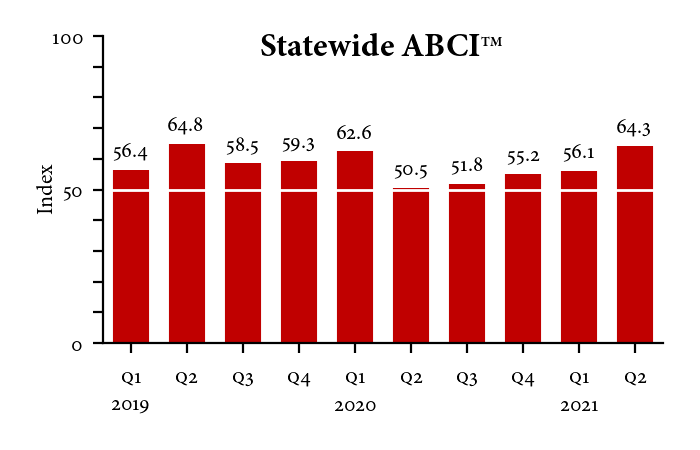
The UA Center for Business and Economic Research’s most recent Alabama Business Confidence Index shows that local business leaders have strong expectations for economic growth in the second quarter of 2021. The statewide business confidence index was 64.3, up more than eight points from the survey of the first quarter of 2021.

It’s one of the highest indexes ever and the most confident business leaders have been in the economy since the second quarter of 2019. It continues a steady recovery of confidence since the early days of the pandemic in the second quarter of 2020, when the ABCI decreased to 50.5 and business leaders were uncertain of what the coming quarter would hold for the economy.

An index over 50 indicates a positive forecast compared to the previous quarter, and the higher the number, the more confident the forecast. The statewide and national forecasts, along with industry-specific components like sales, profits, hiring and capital expenditures comprise the six indexes that combine to make the ABCI total.

“This outlook suggests that business leaders in Alabama are ‘shaking off the pandemic,’” said Susannah Robichaux, a socioeconomic analyst for the center. “When there is a higher ABCI, it signals that business leaders are feeling optimistic about the coming quarter, which is absolutely informing their own decisions about their businesses.”

Business leaders expect to see an increase in sales, profits, hiring and expenditures in the second quarter, according to the survey.

Firms of all sizes reported especially strong confidence in growth compared to last quarter, though small firms with fewer than 20 employees had the most confidence.

In a telling sign from the survey, business leaders feel strongly they will increase hiring in the second quarter compared to the first. Only 6.5% of respondents expected to decrease hiring, and the healthcare and social assistance industry is the only one of nine industry categories that expects to possibly decrease in hiring, hinting at expectations of a possible contraction after a year of industry expansion.

Overall, business leaders are more confident in the state economy than the national outlook, but confidence in both increased from the first quarter of 2021.

The breakdown of all the industry forecasts by sector can be seen in the statewide ABCI report on CBER’s website.

In addition to the statewide ABCI report, CBER also collects ABCI data to write individual reports for Alabama’s five major metro areas. These metro reports offer insight into the forecasts for each specific region.


Examining County Unemployment during COVID-19

  • September 1st, 2020

Authored by: Nyesha C. Black, Ph.D.

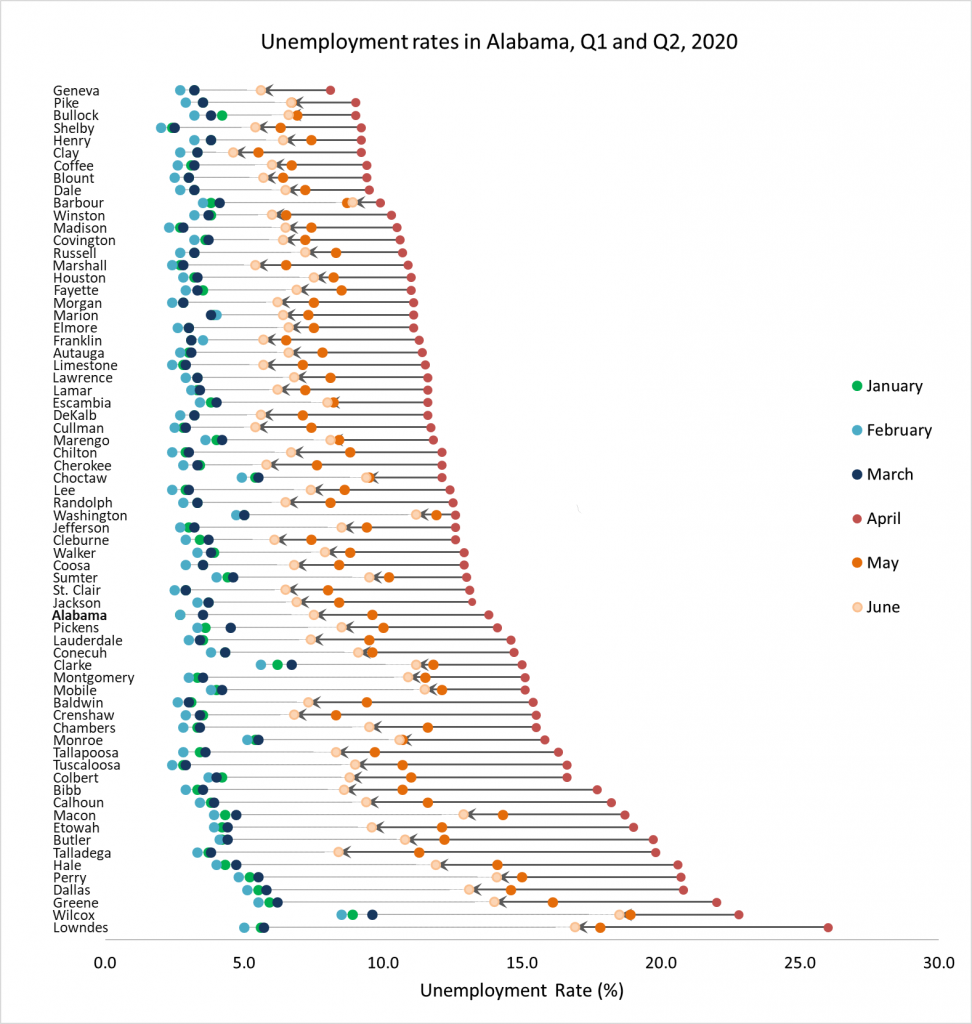
Alabama’s unemployment rate increased by nearly 300% from March to April of this year after stay-at-home orders were implemented to thwart the spread of COVID-19. While this gives us a broad-stroke view of what transpired this spring, it is worth noting that the economic shock of the pandemic affected counties differently. The dramatic variance in unemployment from Q1 to Q2 can be clearly observed in the data visualization below. The graph shows each county’s unemployment rates for January through June as color-coded dots. The unemployment rate peaked in April, among all counties, so those data points were used to sort the counties from lowest peak unemployment rate to the highest.

Scatter plot of unemployment by county for January through June of 2020
Visualization Prepared by The Center for Business and Economic Research at The University of Alabama using data from the Alabama Department of Labor and United State Bureau of Labor Statistics


Even before the pandemic, the unemployment rate varied greatly across the state. For example, the average unemployment rate during Q1 ranged from 2.3% in Shelby County to 9.0% in Wilcox County. However, by Q2, the spread was much more significant. The average unemployment rate ranged from 6.4% in Clay County to 20.2% in Lowndes County. It seems as though the differences in the counties unemployment rates were exacerbated by COVID-19. Several counties in the Black Belt already had higher unemployment rates in Q1 and experienced much higher rates in Q2 than counties with lower unemployment rates in Q1. In April, six counties, all in the Black Belt, had unemployment rates higher than 20%.

In June, unemployment rates rebounded, but the rates were still markedly higher, across all counties, compared to the end of the first quarter. By June, no county had returned to the unemployment rates in Q1, but some counties made better progress than others. For example, Clay County had unemployment rates that were the most comparable to March, but the unemployment rate for the county was still 40% higher in June. In comparison, Montgomery County unemployment rate rebounded the least among all the 67 counties, and had rates that were more than twice as high in June compared to March.

Last Push for Alabama’s 2020 Census

  • August 31st, 2020

As the lead for the Census partnership with the State of Alabama, CBER’s Alabama State Data Center is working to ensure that Alabama Counts! With high stakes on the line, including 2 congressional seats, billions of federal dollars of funding, and the importance of accurate data that will inform planning and decisions for the next 10 years, it is critical that Alabama work hard to get everyone counted before the September 30th deadline.

Alabama currently only has a 61.7% self response rate, but there’s still time to make sure your community participates in the Census. Folks can still self-respond from any computer or smart device at https://2020census.gov/ or can fill out their Census using the official 2020 response line at 884-330-2020.

Below are some links to resources for Alabama’s 2020 Census. Click the headline to read more about them.


Census Bowl has 32 counties compete for $65,000!
As the 2020 Census comes to an end on September 30th, the Alabama Department of Economic and Community Affairs and Alabama Counts! are launching one final effort to boost self-response rates: the Alabama Census Bowl. Thirty-two counties will compete in a March Madness-style bracket to see who can have the greatest increase in their self-response rates each week. The top 8 counties will receive grants for their local public school systems ranging from $20,000 to $64,000. Get involved in your community or follow along here.

In-person Census Follow-Up Response has Begun
Please let your communities know that Census workers have begun going door-to-door to count the households that have not yet responded to the 2020 Census. Census workers have been trained to follow proper health and safety guidelines, and will carry a valid ID badge with their photograph, so you can be confirm their ID. Read more about what to expect here, and share widely!

2020 Census Toolkit – Free Resources
Check out these free 2020 Census promotional materials that include hype videos with Alabama celebrities, informational posters, door hangers, graphics for social media posts, yard signs, and more! There is also specialized material tailored to different community groups and entities, so there’s something for everyone.