
Category: Featured

Using Incentives During the COVID-19 Pandemic

  • May 12th, 2020

Samuel Addy, Ph.D.
Senior Research Economist, Center for Business and Economic Research
Associate Dean for Economic Development Outreach, Culverhouse College of Business
The University of Alabama

From an economic perspective, taking action at every level of government to facilitate or ensure that businesses survive the COVID-19 pandemic is good and proper economic development.  Businesses are important institutions for economies and they generate revenues for governments, especially local ones, while providing services and producing goods.  Businesses that do not survive the pandemic will have to be rebuilt afterward, but rebuilding is more costly than providing assistance (with incentives) to enable survival.  In normal times, use of economic development incentives focuses on growth, but these are not normal times.  Fortunately, local governments in Alabama can use the state’s Amendment 772 to support local business survival since it is in the public interest to do so.  After all, if local businesses do not survive, residents will have to go farther to get the products and services those businesses used to provide and the associated revenues will flow to other areas. Additionally, shrinking or declining economies have reduced attractiveness to economic development prospects and residents can choose to move to the places that have the businesses whose services and products they need or want.

Experience with the COVID-19 virus is clearly showing that conducting business as usual is impossible in this or any other pandemic. To mitigate spreading of the virus—especially since medical tests, supplies, and equipment for dealing with the pandemic are currently inadequate—nonessential business shutdown and stay-at-home responses have been implemented.  These responses reduce demand for many products and services and will cause output of practically all sectors of the economy to decline during this time.  People, institutions people create to make economies function, and natural resources (some of which are converted to structures, equipment, and infrastructure) comprise economies.  People are on both the demand side as consumers and the supply side as workers, innovators and entrepreneurs, investors, proprietors, providers, etc.  Consequently, by endangering people’s lives and health, the COVID-19 pandemic is causing substantial harm to both demand and supply sides of every economy.  Unlike natural disasters where recovery is the focus of responses, pandemics place economies in survivalmode for both people and the institutions (businesses, medical, educational, defense, etc.) used in normal economic times.  As such, the proper response to pandemics is to use resources to address survival first, recovery next, and development later.

Since we are in the survival phase, local Alabama governing bodies could use Amendment 772, when and where applicable, to provide “survival assistance” to existing businesses.  The amendment authorizes local governments to use incentives for economic development (broadly defined to include industrial, commercial, and public development) so long as certain legal requirements are satisfied.  To benefit other parties, this authority permits, (i) using public funds to purchase and/or develop property; (ii) conveying such property; (iii) lending the governing body’s credit or granting public funds; and (iv) borrowing to do the three foregoing activities.  The expenditure of funds must be determined to serve a public purpose.  As explained earlier, using incentives to address existing business survival during a pandemic serves a public purpose.  After the survival phase, these businesses will contribute to local economies again and local governing bodies can return to using incentives solely with a focus on growth.

How much assistance?

How much should the local assistance be?  Local governing bodies can decide this on a case-by-case basis recognizing the unique role of each business seeking assistance or apply a set rule to all applications.  One straightforward decision rule is to apply a set percentage rate to the direct local taxes generated at the establishment in the previous year.  This set percentage rate can be at, above, or below 100 percent.  Considering the assistance in the same way as for a fresh recruitment or expansion is proper in recognition of the fact that during the pandemic businesses may not be operating.  However, for existing businesses with active incentives lower percentage rates may be applied.  The following is an example that applies a 100 percent rate for three different establishments seeking local assistance with normal annual operations as follows: (i) a 40-room, $100 a night, 68% occupancy hotel with 15 workers; (ii) a store with 12 employees and $1 million sales; and (iii) a restaurant with sales of $1 million and 20 workers.


Hotel Store  Restaurant
Sales at establishment $992,800 $1,000,000 $1,000,000
     Direct local (city and county) taxes
        Sales $50,000 $50,000
        Lodgings $69,496
Local COVID-19 assistance (100% of direct taxes, 1 year) $69,496 $50,000 $50,000
NPV (After 5 regular years of operating, 3% discount rate) $241,529 $173,772 $173,772
ROI (After 5 regular years of operating) 348% 348% 348%

The assistance that each business gets is nearly $69,500 for the hotel and $50,000 each for the store and restaurant.  The net present value (NPV) of the assistance and five years of regular yearly direct taxes is about $241,500 for the hotel and $173,800 each for the store and restaurant.  The resulting return on investment (ROI) for the local government is 348 percent.  Tax revenues and assistance are for both the county and municipality involved in the example.  Separate contributions to the assistance can easily be determined using the distribution of the direct tax collections between the two governing bodies or the applicable tax rates.  For example, if the city and county sales tax rates are 3 percent and 2 percent, respectively, then the city contributes 60 percent of the assistance and the county contributes 40 percent.

While determining the assistance as shown in the foregoing is straightforward, it does not take into consideration the fact that economic activities have both direct and indirect effects because of interactions with local clients, suppliers, and workers.  The loss of any of these establishments will result in more than their direct effects in the local economy.  To determine the comprehensive impacts of the establishments requires economic impact analysis, which incorporates economy- and industry-specific multipliers in models that also provide fiscal impacts.  Two popular software sources of multipliers are (i) RIMS II, the Regional Input-Output Modeling System software developed by the U.S. Department of Commerce, Bureau of Economic Analysis, and (ii) IMPLAN, which originated from another federal agency.

The table below shows impacts for the same three establishments that are determined using RIMS II multipliers in an economic and fiscal impact model of an Alabama county.  The economic impacts focus on output, value-added, earnings (wages and salaries), and employment.  Output refers to gross business sales and includes value-added, which is the contribution to gross domestic product (GDP) or the value of goods and services produced on a value-added basis. Earnings impacts are part of value-added and are the wages and salaries of the workers recognized by the employment impact.  The fiscal impacts are conservative because just the major and relevant taxes (sales, property, and lodgings) are considered; for some areas, income taxes may need to be determined as well.  Applying the same 100 percent to the fiscal impacts, the assistance that each business gets is about $97,400 for the hotel, $71,600 for the store, and $78,600 for the restaurant.  The net present value (NPV) of the assistance and five years of regular yearly direct taxes is about $338,500 for the hotel, $249,000 for the store, and $273,200 for the restaurant; the resulting ROI is 348 percent.

The assistance that each business gets is nearly $69,500 for the hotel and $50,000 each for the store and restaurant.  The net present value (NPV) of the assistance and five years of regular yearly direct taxes is about $241,500 for the hotel and $173,800 each for the store and restaurant.  The resulting return on investment (ROI) for the local government is 348 percent.  Tax revenues and assistance are for both the county and municipality involved in the example.  Separate contributions to the assistance can easily be determined using the distribution of the direct tax collections between the two governing bodies or the applicable tax rates.  For example, if the city and county sales tax rates are 3 percent and 2 percent, respectively, then the city contributes 60 percent of the assistance and the county contributes 40 percent.

While determining the assistance as shown in the foregoing is straightforward, it does not take into consideration the fact that economic activities have both direct and indirect effects because of interactions with local clients, suppliers, and workers.  The loss of any of these establishments will result in more than their direct effects in the local economy.  To determine the comprehensive impacts of the establishments requires economic impact analysis, which incorporates economy- and industry-specific multipliers in models that also provide fiscal impacts.  Two popular software sources of multipliers are (i) RIMS II, the Regional Input-Output Modeling System software developed by the U.S. Department of Commerce, Bureau of Economic Analysis, and (ii) IMPLAN, which originated from another federal agency.

The table below shows impacts for the same three establishments that are determined using RIMS II multipliers in an economic and fiscal impact model of an Alabama county.  The economic impacts focus on output, value-added, earnings (wages and salaries), and employment.  Output refers to gross business sales and includes value-added, which is the contribution to gross domestic product (GDP) or the value of goods and services produced on a value-added basis. Earnings impacts are part of value-added and are the wages and salaries of the workers recognized by the employment impact.  The fiscal impacts are conservative because just the major and relevant taxes (sales, property, and lodgings) are considered; for some areas, income taxes may need to be determined as well.  Applying the same 100 percent to the fiscal impacts, the assistance that each business gets is about $97,400 for the hotel, $71,600 for the store, and $78,600 for the restaurant.  The net present value (NPV) of the assistance and five years of regular yearly direct taxes is about $338,500 for the hotel, $249,000 for the store, and $273,200 for the restaurant; the resulting ROI is 348 percent.


Input Data Hotel Store Restaurant
Sales at establishment $992,800 $1,000,000 $1,000,000
     Operation employment (jobs) 15 12 20
     Annual payroll (does not include benefits) $405,000 $300,000 $420,000
Economic Impacts (direct and indirect)
     Output (Gross Business Sales) $2,948,408 $2,296,254 $2,830,432
        Contribution to GDP $1,823,044 $1,435,655 $1,563,780
            Earnings (Wages and Salaries) $658,571 $510,720 $675,612
     Employment (Jobs) 21 17 26
Fiscal Impacts (direct and indirect)
     Local (city and county) taxes
        Sales $13,962 $60,827 $64,323
        Property $13,933 $10,805 $14,293
        Lodgings $69,496 $0 $0
        Combined local taxes $97,390 $71,632 $78,616
Local COVID-19 assistance (100% of direct taxes, 1 year) $97,390 $71,632 $78,616
NPV (After 5 regular years of operating, 3% discount rate) $338,473 $248,953 $273,225
ROI (After 5 regular years of operating) 348% 348% 348%

Note: Rounding errors may be present.


Conclusion

Local government use of Alabama Amendment 772 to provide assistance to existing local businesses during the COVID-19 pandemic is prudent. This is because the cost of rebuilding existing businesses that do not survive the pandemic is far higher than providing such assistance to ensure survival.  The local support will facilitate eventual recovery and development when the pandemic is controlled; incentive use can then return to focusing on growth purposes only as is normally done with application to new and expanding businesses.


Update on Alabama’s 2020 Census Participation Rates

  • May 7th, 2020

The 2020 Census is well underway, and despite disruptions related to the coronavirus pandemic, efforts to ensure maximum participation in Alabama continue. The state’s participation rate was 68% in 2000 and 72% in 2010, and every effort is being made to ensure participation rates in 2020 continue to improve. One way to follow along with the 2020 Census is to keep up with the rate of self-response on this interactive web tool that tracks participation in real time.

As of May 4, 2020, Alabama’s participation rate is 54.8%, compared to a national participation rate of 56.8%. With the exception of Tennessee at 56.1%, Alabama’s current participation rate is higher than its neighboring states: Georgia’s participation rate is 53.1%, Mississippi’s participation rate is 52.3%, and Florida’s participation rate is 54.5%. At the county level, Shelby (68.8%), Madison (67.3%), and Autauga (64.5%) counties are leading the way in participation rates, while Coosa (25.3%), Perry (27.6%), and Sumter (30.8%) counties have the most room for improvement during the summer and early fall.

Due to the COVID-19 pandemic, the US Census Bureau has revised its schedule of operations to ensure there is still plenty of time for households to complete their forms and enumerators to follow-up with the remaining households. The self-response phase will now run three months longer, ending on October 31, 2020 as opposed to the original date of July 31, 2020. Participating in the census has never been easier thanks to the online self-response option! All you need is the internet and your home address, and you can complete the 2020 Census questionnaire in less than five minutes. Make sure to encourage your friends and family to fill out their census and help Alabama Count! 

For more information about 2020 Census participation rates at the state, congressional district, county, city, and census tract level, check out the following interactive tool. 

Link to response rate maps. 


Thousands of Alabama Addresses Added in 2020 Count Review

  • March 31st, 2020

Logo for Alabama 2020 Census

Staff from the Center for Business and Economic Research (CBER) recently participated in the Census Bureau’s Count Review Event.  The Count Review Event is a nation-wide effort coordinated by the Census Bureau to improve the quality of their Master Address File, which is the list of addresses the Census Bureau will work from while conducting the 2020 Census.  This effort contributed to enhancing the accuracy and completeness of the 2020 Census.  CBER staff members involved in the Count Review Event included Viktoria Riiman, Shannon Murphy, Susannah Robichaux, Stephanie Normanyo, and Kilungu Nzaku.

To prepare for the Count Review Event, CBER staff put out a call to city- and county-level stakeholders throughout Alabama in an effort to gather up-to-date lists of group quarter and housing unit addresses.  The help these stakeholders offered was absolutely essential during the Count Review Event, as they provided the lists of addresses that were checked against the Census Bureau’s Master Address File.  If the addresses were not already included in the Census Bureau’s Master Address File, they were flagged for possible inclusion during the 2020 Census counts of each state’s total population, housing units, and group quarters.

The 2020 Count Review Event was held during a four-week period earlier this year, from January 13 to February 6.  The first half of the Count Review Event focused on group quarters, which include non-federal correctional facilities, nursing facilities, college/university on-campus housing, military barracks, workers’ group living quarters, and job corps facilities.  Thanks to the hard work of CBER staff, 200 group quarter addresses were added to the Census Bureau’s Master Address File for Alabama to include people who otherwise would not have been counted during the 2020 Census.  The second half of the Count Review Event focused on residential housing units.  During this phase of the event, CBER was able to add 21,470 housing units that were new to the Census Bureau’s Master Address File and matched to the United States Postal Service’s address files.  These housing unit addresses are being sent to the next step of reconciliation for possible addition to the Census Bureau’s workload in counting people who live in residential homes.

The 2020 Census is very important to the future of Alabama and CBER staff are doing their part by making sure the Census Bureau’s Master Address File is as accurate and complete as possible.  Remember—Alabama Counts!

COVID-19 and the Economy

  • March 31st, 2020

In the midst of the uncertainty caused by the COVID-19 pandemic, CBER’s experts are here to offer some insight. Sam Addy, Associate Dean for Economic Development Outreach & Senior Research Economist, and Ahmad Ijaz, CBER’s Executive Director & Director of Economic Forecasting weigh in with what we can expect in our local and national economies in the coming months.

People are at the core of the economy, playing roles on both the demand side as consumers and the supply side as workers, innovators, investors, entrepreneurs, proprietors, providers, etc. As such, the health of people and their educational attainment are key to development. People’s health is crucial because healthy people can learn and contribute, but sickness makes people unable to contribute regardless of how educated and skilled or talented they may be. By presenting a danger to people’s health, the novel coronavirus (COVID-19) pandemic has the potential to cause substantial harm to every local, regional, national, and the global economy.

The proper response to this danger is to use resources to address survival first, recovery next, and development later. It is important to note that pandemics occur within economies and so are not separate from them. As such, the nature of the response determines the resulting state of the economy; a good response will result in a better economy than an abysmal response would. Survival and recovery require significant resources, but are necessary to ensure that when the pandemic is controlled, the essential human capital, physical and natural/environmental capital, and public and private institutions will still be available to enable a renewed focus on development. Fortunately, the United States has the resources (human, financial, institutions, and infrastructure) to work this Survival-Recovery-Development strategy even if controlling the pandemic takes 18 months as some medical experts have predicted. In addition, even if the nation’s wealth falls considerably in the process of confronting the pandemic, the nation will still be very affluent afterward.

United States

COVID-19 will cause all sectors of the economy to experience negative effects during this time, but firms in certain sectors (e.g., health-related, logistics, communications and technology, repurposed manufacturing) could fare better than others. While the direction of effects is clearly that there will be contraction from earlier expectations and forecasts, the magnitude is unknown at this time since the direct health effects are themselves unknown. It will depend greatly on (i) governmental policies and actions that are adopted and implemented at all levels (federal, state, and local) and (ii) how people behave; specifically, how seriously they take and respond to directives and policies. From a resource perspective, the composition, design, and size of the response packages that Congress and the Federal Reserve put in place will be of utmost importance. Response to the pandemic must include a medical component to people and health-related institutions for survival as well as assistance to people, government, businesses and other institutions (both nonprofit and for profit) for survival and economic recovery.

The financial accounts of the United States (FAUS) show that household net worth rose to $113.8 trillion in the fourth quarter of 2019. This is net of $53.9 trillion in domestic nonfinancial debt outstanding ($16.0 trillion household debt, $16.0 trillion nonfinancial business debt, and $21.9 trillion government debt). In 2018, U.S. gross domestic product (GDP) was $20.6 trillion and total employment was about 200.7 million (154.4 million wage and salary employment and 46.4 million proprietors). Personal income was $17.8 trillion, of which wages and salaries totaled $8.9 trillion. State and local governments had total revenue of $3.9 trillion in 2017 with $710 billion coming from federal coffers. COVID-19 will cause severe declines in GDP, personal income, employment, wages and salaries, government revenues, and other relevant economic indicators. The above-mentioned data suggest that survival and recovery for the nation during this pandemic will require injection of about $1 trillion a month, which the FAUS data suggest that the nation can afford.

Alabama

Alabama accounts for 1.1 percent of U.S. GDP and 1.5 percent of the population, which defines a potential range regarding COVID-19 impacts on the state economy relative to national impacts. For example, a $1 trillion national impact could mean an $11 billion to $15 billion impact on Alabama. However, several factors can make the range larger or smaller. These include the nature of the impacts, the behavioral component of the response, and differences in demographics and economic structure. Second quarter Alabama GDP will most likely decline by about 3-4 percent, with employment falling much faster. Any recovery in the third quarter will be quite weak due to supply-side constraints facing Alabama manufacturers and weak consumer demand and business spending. Optimistically, the state economy will be back on a normal path of recovery by the fourth quarter.

Portions of the economy at risk of significant declines include travel and travel-related businesses, food services and eating places, tourism and leisure, support services, auto dealers, gas stations, education, manufacturing firms that rely on exports and/or overseas suppliers for their inputs, and other businesses that depend on consumer and business spending. These firms together employ nearly 1.2 million workers (or about 58 percent) of the total nonfarm employment in the state and their multiplier effects on the rest of the state’s economy could make it difficult for the economy to recover in the third quarter. Furloughs and layoffs will be common. The expected significant declines in economic activity will adversely affect income, sales, lodging, gas, and other tax revenues for both state and local government entities.

Business investment spending has been mostly weak for the last couple of years. COVID-19 effects and the large drop in oil prices will most likely push business spending into much deeper negative territory. Weaker economic growth in the rest of the world will also hurt Alabama’s exports; in 2019, Alabama exports to China, the state’s third largest trading partner, totaled $2.2 billion, about 11 percent of the state’s total exports. The global economy is most likely already in recession. Overall, the length of the downturn and the subsequent recovery will depend on how strong the policy responses (both monetary and fiscal) are and how these policies help businesses, state and local governments, and households weather the shock of the COVID-19 pandemic.


CBER Reviews Alabama Addresses for 2020 Census

  • March 3rd, 2020

The Center for Business and Economic Research (CBER) is working with the U.S. Census Bureau to ensure a complete count for the 2020 Census by reviewing Alabama’s address files. Local governments and planning agencies responded to our call for data, and CBER was able to verify, clean, and update addresses throughout the state. These addresses were submitted to the Census Bureau, where they will be added to the Census Master Address File and used to enumerate the 2020 Census.

At CBER we know that good data is essential for quality analyses and impactful results. This is why CBER is taking its role in the 2020 Census Count Review seriously. A recent study by George Washington University shows that in FY2016 Alabama was allocated over $13 billion in federal funding to support programs throughout the state. This funding is based on data collected in the decennial census, and an undercount in 2020 could mean underfunding for essential federal programs throughout Alabama like Medicaid; SNAP; Highway Planning and Construction; and Pell Grants, to name a few. 

Alabama’s address files for the 2020 Census are looking great, thanks to cooperation from local governments and planning agencies throughout the state. Now, it is up to you to participate and encourage others to do the same. Invitations to participate in the 2020 Census will arrive in the mail March 12-20 with instructions for responding online, so stay on the lookout for this exciting and important way to make sure that Alabama Counts!

Workforce Training Remains Top Issue in 2019

  • March 3rd, 2020

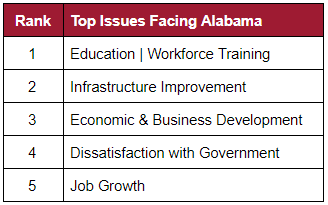
Education and workforce training remains the top issue facing Alabama, according to the 2019 Alabama Business Confidence Index (ABCI) Panelist Poll.

The Center for Business and Economic Research (CBER) in The University of Alabama’s Culverhouse College of Business conducts an annual survey of Alabama business leaders to determine the top issues facing the state and their respective companies.

Table of top issues facing Alabama: first is education and workforce training; second is infrastructure improvement; third is economic and business development; fourth is dissatisfaction with government; and fifth is job growth.

This is the third year that panelists have identified education and workforce as the top issue facing Alabama. In the 2019 survey, 84.7 percent of panelists reported concern about the state of the education and workforce training system, with specific concerns for the lack of funding for K-12 improvements; a desire for including a more career-focused curriculum in high school and junior colleges; and hopes for increased availability of workforce training programs. The goal of these improvements would be to create a more highly-trained workforce throughout the state to fill these higher-skilled positions.

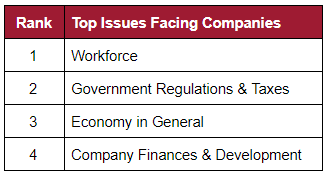
Table of Top Issues Facing Companies: First is Workforce; second is government regulations and taxes; third is economy in general; and fourth is company finances and development

The importance of this issue was echoed when panelists were asked about the top issue facing their individual companies. Having access to skilled or experienced workers allows businesses to thrive and grow, but many panelists are concerned about Alabama’s workforce. In the 2019 ABCI Panelist Poll, 72.2 percent of respondents reported difficulty in attracting and retaining qualified workers.

In addition to workforce concerns for the state, over half of the Alabama business leaders surveyed also included infrastructure, economic and business development, and dissatisfaction with government as the top issues facing Alabama in 2019. A significant portion of businesses were also concerned about job growth. When asked for the top issues facing their individual companies, panelists included government regulation and taxes, the economy in general, and company finances and development in the 2019 survey. The ranking of both lists of issues has remained consistent for the past two years.

Each quarter, business leaders respond to the ABCI survey and receive the reports that summarize the business sentiment for the state and its four largest metro areas. When asked how they use the results, over 80 percent of the 2019 panelists said they use it as a general indicator of local and regional economic outlook. About 47 percent use the ABCI reports to compare their personal projections to others’ viewpoints, and 40 percent use it as background information for their own forecasts. About 22 percent of business leaders who responded to the Panelist Poll use the ABCI reports for economic development, decision-making, or short-term planning, while that same percentage share the results with others.

The ABCI panel is open to business executives across the state. Registration and current and historical results are available on the ABCI page of CBER’s website. Newsletters with results are provided for Alabama and for the Birmingham-Hoover, Huntsville, Mobile, and Montgomery metro areas. Panelists can take the Q2 2020 survey until March 15. For questions, please contact socioeconomic analyst, Susannah Robichaux at scrobichaux@cba.ua.edu.

Alabama Business Confidence Strengthens in 2020

  • February 5th, 2020

Business leaders throughout Alabama continued to express strong confidence in economic growth in the first quarter of 2020, with a very positive outlook for increased industry sales and profits, and the general strengthening of Alabama’s economy. This is shown in the latest results for the Alabama Business Confidence Index (ABCI), a quarterly survey of statewide business sentiment conducted by the Center for Business and Economic Research in UA’s Culverhouse College of Business. Highlights of this quarter’s reports include an industry breakdown of results with retail trade leading in confidence; strong optimism from the Montgomery, Mobile, and Huntsville metro areas; and small businesses continuing to have the highest ABCI. To read more about the Q1 2020 results, visit the ABCI page, where you can find the most recent results as well as download historical reports and data.

What is the ABCI?

Each quarter, CBER reaches out to business leaders throughout Alabama with a simple survey about their expectations for the coming quarter. Four of the six questions gauge the panelists’ specific industry expectations, including their sales, profits, hiring, and capital expenditure, and the remaining two focus on the general economic conditions in Alabama and the US. Once CBER has analyzed the results, reports offering insight into statewide business confidence, as well as the state’s four largest metro areas (Birmingham-Hoover, Huntsville, Mobile, and Montgomery), are available on the ABCI page of CBER’s website. Alabama businesses, as well as local governments and chambers of commerce, use the ABCI to get a feel for the business community’s expectations or measure their own forecasts against.

How do I become an ABCI panelist?

Any person who leads a business in Alabama is welcome to become a panelist. You can register here, or from the ABCI homepage.

Dr. Sam Addy Presents to Alabama Economics Club

  • February 5th, 2020

BIRMINGHAM, Ala. — Dr. Sam Addy, Associate Dean for Economic Development Outreach and Senior Research Economist at Center for Business and Economic Research (CBER), is known throughout Alabama and the US as a knowledgeable researcher and vivacious presenter. Dr. Addy is a highly sought after presenter as an expert on topics like the Alabama economy, economic policy, economic development, workforce development, and many more. On January 17, he lived up to his reputation, delivering an entertaining and informative presentation on the economic impact of the University of Alabama on the state to the Alabama Economics Club (AEC) in Birmingham.

In his presentation, Dr. Addy broke down the fundamentals of economic development and then emphasized the education’s role in that process. He went on to specifically address the University of Alabama’s economic impact on the Tuscaloosa Metro Area and the State of Alabama as a whole. For more details, you can view his presentation here or visit the UA Impact Report page on the CBER website.

Dr. Addy is no stranger to the AEC; he is a founding member and has been instrumental in the growth of the organization. The Alabama Economics Club is now the state’s premier professional association for business economists and those interested in economics. The club is the Alabama chapter of the National Association of Business Economics (NABE), an organization that has attracted the brightest minds and the most prominent figures in economics, business, and academia to its membership since its inception in 1959. The AEC hosts luncheons every other month featuring speakers who are experts in their fields, offering attendees the opportunity to learn something new and network with other Alabama professionals. Though the quality of the presentation is always high, there is a lot of variety in the speakers’ occupations, with professionals coming from the private industry, economic development, the Federal Reserve, and more. For more information on the club, visit their Facebook page.

As always, CBER’s staff may make presentations at conferences and meetings for an honorarium. To learn more about all the work CBER does, visit our What We Do page. To schedule an event, email uacber@cba.ua.edu or call (205) 348-6191.

Alabama Counts! 2020 Census Campaign Kicks Off

  • February 4th, 2020

MONTGOMERY, Ala. — 2020 Census efforts are well underway in Alabama as the decennial census is right around the corner. Susannah Robichaux, a socioeconomic analyst for the Center for Business and Economic Research (CBER), traveled to Montgomery on January 22 to participate in the launch of the Alabama Counts! 2020 Census campaign. CBER is proud to be working with Governor Ivey, the Alabama Department of Economic and Community Affairs (ADECA), and the U.S. Census Bureau to support Alabama’s 2020 Census efforts. The speakers at the January 22 kick-off meeting covered some important topics.

Kenneth Boswell, director of ADECA and chairman of Alabama Counts, kicked off the event by acknowledging the incredible work that Alabama has already put forth. ADECA is funding $1 million worth of grants to support grassroots efforts that will boost decennial census participation with hard-to-reach communities, as well as travelling throughout the state to develop partnerships and help communities organize local census committees.

Governor Kay Ivey spoke to the need for an accurate and full count for the state, emphasizing the impact of the 2020 Census on Alabama’s presence in the House of Representatives and the allocation of federal funding for schools, healthcare, and job opportunities in our state. She finished her presentation with a call to action: “Let’s work together to make sure Alabama Counts!”

ADECA is working with Big Communications Inc. to get the word out about the 2020 Census in Alabama. Senior strategist, Ally Clokey, presented Big Communcations’s research and strategies at the meeting. The marketing firm has put together profiles for each county that include details to help each county connect with their specific population. In addition, Big Communications has also created a wealth of campaign resources for local organizations, including posters in English and Spanish, social media assets, yard signs, a Powerpoint deck, and more. All of these assets can be personalized and are available on the Alabama 2020 Census resources page.

Carletta Singleton, Partnership Coordinator for the U.S. Census Bureau’s Alabama division, praised the state’s outreach efforts and encouraged people to continue supporting local efforts. March 12 marks the beginning of the 2020 Census, with online response opening that day. The Alabama census office will pay close attention to participation rates from March through July, and will coordinate with local partners to help increase awareness in low-response regions. Singleton also reminded attendees that the Census Bureau is hiring enumerators through March 30. These temporary jobs start at $14 per hour, and are great part-time work for anyone wanting to help make sure their local community counts. Anyone interested can apply on the 2020 Census website.

As the lead for the Alabama State Data Center (ASDC), the official partnership between the U.S. Census Bureau and the State of Alabama, CBER helps disseminate data locally and coordinate workshops to help communities prepare for the 2020 Census. The analysts at CBER know just how important a successful count is to the state and are doing everything they can to help make sure Alabama Counts!

2020 Economic Outlook

  • January 15th, 2020

2020 Economic Outlook Conference Review

The Center for Business and Economic Research (CBER) held the 2020 Economic Outlook Conference January 9, 2020 at the Capital City Club in Montgomery. Attendees from all over the state gathered to network and get some perspective into what 2020 might have in store for the state. Speakers included several CBER staff members, as well as David Altig, Executive Vice President and Director of Research at the Federal Reserve Bank of Atlanta, and David Bronner, Chief Executive Officer of the Retirement Systems of Alabama. The presentations from the conference are now available on our CBER’s website on the Alabama Economic Outlook page, offering a chance to review some of the very interesting perspectives shared this year. Thanks to all who attended this year’s conference, and we hope that if you weren’t able to make it this year, you’ll join us for 2021.