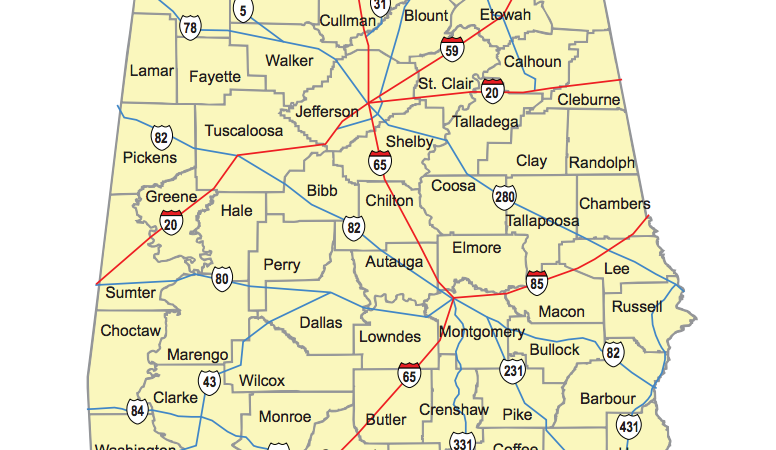
Alabama Highways
- July 30th, 2019

The town of Madison was the fastest-growing sizeable city in Alabama from 1990-96 with a population growth of 8,828 people, according to U.S. Census Bureau data released by the Alabama State Data Center at The University of Alabama.
Center Director Annette Watters said Madison, a bedroom community for high-tech Huntsville, posted a 59.7 percent growth rate, up from 14,792 residents in 1990 to 23,620 residents in 1996. On the flip side of the coin, these latest official population estimates show the city of Birmingham continuing to lose in the numbers game.
“According to the new Census estimates, Birmingham had 6,804 fewer people in 1996 than it had in 1990, when its recorded population was 265,347 residents,” said Watters, who was recently elected director of the Washington, D.C.-based national State Data Center. “This also means that Birmingham dropped from a ranking of the 60th largest city in the nation in 1990 to the 63rd largest in 1996.
“Gadsden, which is also in the top 10 Alabama cities, also showed a net loss of 1,368 people during the same time period,” she said. “The city of Mobile, however, retained its rank of 79th largest in the nation, and the city of Montgomery rose from 84th largest in the country to 82nd largest in 1996.”
Watters noted there are also some confusing numbers in the latest statistics released by the Bureau of the Census.
“Two major cities in the state, Hoover and Huntsville, appear to have gained the most people since 1990,” she said. “But both those municipalities filed formal challenges with the Census Bureau earlier in the decade protesting previous population figures.
“The Bureau agreed with them after reviewing documentation the cities provided, so these 1996 estimates of 38.7 percent growth by Hoover and 6.6 percent by Huntsville reflect not only the growth in these dynamic cities, but also the adjustments made during the time period,” Watters explained. “Therefore, it’s really hard to say which city has gained the most people during the decade because of the unusual situations of those two cities.
“Also, the 1996 estimates were done with a different methodology from previous estimates.”
Watters explained that because of this new way of estimating the population, some cities and towns show more or fewer people than the last time the population was estimated (figures were released in October 1995). She also offered a caution to civic leaders who might want to interpret the latest Census data as “the gospel.”
“We need to remember that these are estimates, not literal truth,” she said. “If the elected officials of a town believe their estimates are in error, the Census Bureau is very willing to consider changing the number – but the city has to produce proof, not just rhetoric or anecdotal evidence.
“Several towns and cities in the state have shown the Census Bureau that they failed to account for something important, and the totals for those cities have been changed during the decade,” the director said. “A ‘challenge’ is not an adversarial process; it is just the paperwork of providing the federal agency the documentation it needs to make a correction.”
Watters noted that towns that have incorporated since the 1990 census are not included in this round of population estimates; also, she said, if a city has experienced a growth spurt during this calendar year, that will be reflected in future estimates.
The University of Alabama Culverhouse College of Commerce and Business Administration, founded in 1919, was renamed this year in honor of late philanthropist and UA alumnus Hugh F. Culverhouse. The College, which first began offering graduate education in 1924, was the only business school in the state listed in the latest edition of the prestigious Princeton Review, which cited the high quality and moderate cost of the school’s flagship MBA program.
TEN LARGEST CITIES IN ALABAMA

    CITY             1996 POPULATION ESTIMATE

1.  Birmingham                258,543
2.  Mobile                    202,581
3.  Montgomery                196,363
4.  Huntsville                170,424
5.  Tuscaloosa                 82,379
6.  Dothan                     55,944
7.  Hoover                     55,464
8.  Decatur                    53,797
9.  Gadsden                    41,155
10. Florence                   38,999
**11/97
Since John Maynard Keynes popularized the concept, the “multiplier” has received a lot of attention. Unfortunately, it is often misunderstood and misapplied, with potentially disastrous effects. This article does not replace a more detailed treatment of the multiplier, but it does discuss some of the misunderstandings and how to protect against misapplying the concept.
The Foundation
A multiplier is based on the disarmingly simple notion that the expenditures of one person represent the income of another. The expenditures of the second person become the income of a third, and so forth. The size of a multiplier depends on at least three things: (1) the economic activity involved, (2) the time period under consideration , and (3) the size of the area being considered.
Since spending takes time, the size of the multiplier effect is different for a week, a month, or a year. The longer the time period, the more rounds of respending, and the higher the multiplier. If the period of time under consideration is infinitely long, the multiplier of any initial round of spending would be infinite! However, that never happens. To quote Herbert Stein, former chairman of the Council of Economic Advisors, “things that can’t go on forever, don’t.”
The Concept of Leakages
In our hypothetical story, each person spends all the money he receives (e.g., savings do not exist). But what if people do not respend all their income? Let us assume that individuals decide to spend only 80 percent of their new income. Now when a person receives $1.00 he respends only 80 cents. The next person receives 80 cents, but respends only 64 cents (80 percent of 80 cents), etc. Each round gets progressively smaller as income “leaks” out of the spending stream. The greater the leakage (that is, higher levels of savings), the smaller the multiplier.
Geography Also Matters
Our illustration is valid if we are talking about Planet Earth, since all spending and saving must occur within the borders of the world. However, if we are interested in finding a multiplier for the United States, there is an additional consideration. Some spending will leak out of the United States to pay for imports. This leakage has the same effect on the multiplier as does an increase in savings. That is, the more money is spent out of the country, the smaller the multiplier for the United States.
When considering smaller geographies such as states, counties, or cities, even greater leakages occur. Thus the smaller the geography, the smaller the multiplier. Multipliers for large cities, densely populated counties, and big states are larger than those for small areas. The important factor determining the size of the multiplier for any community is, of course, not square miles, but the ability to capture all economic linkages within the community without allowing money to leak into someone else’s economy.
Summary
Properly understood and applied, the multiplier is important in measuring the effects of changes in an economy. However, one size does not fit all when it comes to multipliers. Each activity, community, and time period under analysis is important in determining the size of the multiplier.
**11/97
In 1975 Alabama’s total live birth rate was at its lowest. That year there were 57,922 births, compared to 70,589 births in 1965. Children born in 1975 became 16 years old in 1991-eligible for the labor force-and since 1991 Alabama employers have been feeling the effects almost annually of declining birth rates. So what has caused the decline in birth rates and how does that affect the labor force? Reasons for declining birth rates include 1) the effects of higher education, 2) increased access to abortion, 3) more women entering the labor force, and 4) the aging of the population.
First, consider that in 1995 the students in Alabama’s public universities were 55.5 percent women. Private institutions’ enrollment was 57.4 percent female. As women attain higher education, the number of births fall. In 1993, for those women whose highest degree was a high school diploma, 22,502 births were recorded. For women who had four-plus years of college the number of live births decreased to 9,563.
Second, in terms of abortion, the National Bureau of Economic Research found that the states that legalized abortions in 1970 experienced a five percent decline in births relative to other states. When abortion became legal in 1973, the differences in these numbers disappeared. According to these researchers, if abortion were banned in the United States, there would be a seven to eight percent rise in the birth rate, or a possible 350,000 additional births per year.
The third factor affecting birth rates is the increase of women in the labor force. By 2005, 48 percent of the labor force will be women as opposed to 43 percent in 1983. As women move their focus from homemaking to becoming defined members of the labor force, the birth rate declines.
Lastly, America’s labor force is aging. As baby boomers grow older, they account for a larger part of the labor force. By the year 2000, nearly one-third of the working population will be over the age of 55, classifying them as “older workers.” This relates to a decrease in births since older women do not have a large number of births later in life. In 1993 women in Alabama between the ages of 20 and 24 accounted for the most live births with 19,440, while those women between the ages of 40 and 44 accounted for 542 live births.
The end results of these factors are not necessarily all negative-labor shortages, wage pressures, and large turnover rates. The declining birth rate has had some positive effects on the labor force. Because of an aging population and declining growth of the labor force, human resource policies are changing. Companies are offering incentives to keep older workers working past retirement age. Older workers can sometimes replace the lack of younger employees. Opportunities like flextime, part-time, temp work, job sharing, and extended vacations are becoming more common for employees of all ages. Businesses are learning that people of all shapes, sizes, ages, colors, and backgrounds can be good workers.
Kelly Johnson
Graduate Research Assistant
Alabama added 31,976 new residents between July 1, 1996 and July 1, 1997, according to estimates released by the U.S. Bureau of the Census. Alabama’s 1997 population of 4,319,154 was 0.7 percent higher than the 1996 total of 4,287,178. An estimated 13,212 more people moved into the state than moved out during the year. From the 1990 census through July 1, 1997, the state’s population increase totaled 278,765, a 6.9 percent gain that ranks the state twenty-third in population growth for the 1990s. The 1997 round of population estimates resulted in upward revisions of all of Alabama’s annual estimates since the 1990 census.
Overall, the nation’s population rose 0.9 percent from 1996 to 1997 to total 267,636,061. Led by Nevada’s population gain of 4.8 percent and Arizona’s 2.7 percent increase, the West was the fastest growing region in the country with an average gain of 1.6 percent. California showed the largest numerical increase of any state with 410,000 new residents, representing a 1.3 percent increase. At 1.3 percent, the South ranked second in overall regional growth. Georgia led the South with a population increase of 2.1 percent. Texas posted a 1.8 percent increase, while Florida and North Carolina each gained 1.6 percent. Population growth in the nation’s Midwest region averaged 0.5 percent, while the Northeast saw just a 0.2 percent gain. Pennsylvania’s population was down 20,000, the largest numerical loss of any state.
Population estimates incorporate revisions of estimates from previous years and the results of special censuses and test censuses conducted by the Census Bureau.
Births – Births are the number of live births occurring to residents of an area during the period as reported from the Census Bureau’s Federal-State Cooperative Program for Population Estimates (FSCPE) and the National Center for Health Statistics.
Census Regions and Divisions – Statistics for states are totaled for the four census regions and nine census divisions in the top lines of each table.
The Northeast region includes the New England division: Connecticut, Maine, Massachusetts, New Hampshire, Rhode Island, and Vermont; and the Middle Atlantic division: New Jersey, New York, and Pennsylvania.
The Midwest region includes the East North Central division: Illinois, Indiana, Michigan, Ohio, and Wisconsin; and the West North Central division: Iowa, Kansas, Minnesota, Missouri, Nebraska, North Dakota, and South Dakota.
The South region includes the South Atlantic division: Delaware, District of Columbia, Florida, Georgia, Maryland, North Carolina, South Carolina, Virginia, West Virginia; the East South Central division: Alabama, Kentucky, Mississippi, and Tennessee; and the West South Central division: Arkansas, Louisiana, Oklahoma, and Texas.
The West region includes the Mountain division: Arizona, Colorado, Idaho, Montana, Nevada, New Mexico, Utah, and Wyoming; and the Pacific division: Alaska, California, Hawaii, Oregon, and Washington.
Deaths – Deaths are the number of deaths occurring within the resident population of an area during the period as reported by the Census Bureau’s Federal-State Cooperative Program for Population Estimates (FSCPE) and the National Center for Health Statistics.
Demographic Components of Change – The demographic components of population change consist of natural change and net migration. Natural change is defined as births minus deaths. Net migration is the difference between all forms of migration into and out of an area.
Natural Change – Natural change is the difference between the number of births and the number of deaths.
Net Domestic Migration – Net domestic migration (“NDM”) is the difference between domestic in-migration to an area and domestic out-migration from it during the period. Domestic in-migration and out-migration consist of moves where both the origins and destinations are within the United States (excluding Puerto Rico).
Net Federal Movement – Net federal movement is the difference between the movement of federal employees (both military and civilian) and their dependents into and out of the United States (excluding Puerto Rico) during the period.
Net International Migration – Net international migration (“NIM”) is the difference between migration to an area from outside the United States (immigration) and migration from the area to outside the United States (emigration) during the period. For the purposes of these population estimates, the geographic extent of the United States is defined as excluding Puerto Rico. More specifically, net international migration consists of
1) legal immigration to the United States as reported by the Immigration and Naturalization Service,
2) an estimate of net undocumented immigration from abroad,
3) an estimate of emigration from the United States, and
4) net movement between Puerto Rico and the (balance of) the United States.
Net Movement from Abroad – Net movement from abroad is the sum of net international migration and net federal movement during the period.
Population (Census) – The April 1, 1990 census population is a count of the number of persons residing in an area (resident population) as reported in the 1990 Census of Population, or as subsequently revised. Revisions to an area’s 1990 census population count may occur as the result of
1) post-1990 census corrections of political boundaries, geographic misallocations, or documented under-enumerations or over-enumerations, and
2) geographic boundary updates made subsequent to the 1990 census, which include annexations, new incorporations, mergers, etc. The closing date for these two forms of revisions was December, 1996.
Population Change – Population change (“Pop chg”) is the difference between the population of an area at the beginning and end of a period. It is expressed numerically (“Numerical”) and as a percentage (“Percent” or “%”) of the beginning population.
Population (Estimate) – The estimated population is the computed number of persons living in an area (resident population) as of July 1. The estimated population is calculated from a demographic components of change model that incorporates information on natural change (births and deaths) and net migration (net domestic migration and net movement from abroad) that has occurred in the area since the reference date of the 1990 census. Additional information on the methodology used to produce these population estimates is contained in Current Population Reports P25-1127 and at the Census Bureau’s Internet site with URL of http://www.census.gov/population/www/methodep.html.
Resident Population – These population estimates are for the resident population. The resident population of a state includes all residents (both civilian and Armed Forces) living in the state. The geographic universe for the resident population is the 50 states and the District of Columbia. It excludes Puerto Rico and outlying areas under United States jurisdiction. The resident population excludes U.S. citizens residing abroad.
Residual – The subnational estimates are constrained to sum to an independently derived estimate of the national population. The residual is the difference between an area’s population as estimated by the subnational population estimation procedure before and after imposing this constraint. The residual is not a demographic component of population change; rather, it is a statistical artifact of the procedures employed in producing the estimates.
Source: Population Estimates Program, Population Division, U.S. Bureau of the Census, Washington, DC 20233, January 9, 1998.
**01/98