

Category: Featured

How Can the 2020 Census Improve Alabama’s Rural Health Care?

  • November 5th, 2019

National Rural Health Day 2019

November 21, 2019 is National Rural Health Day. There are many health care challenges that disproportionately affect rural areas in Alabama, including the loss of rural hospitals and a need for funding to provide health insurance to the uninsured. These issues can be helped by federal funding that is allocated to states based upon responses to the decennial census.

According to the Alabama Hospital Association, seven rural hospitals have closed throughout the state in the last eight years due to the financial challenges faced by rural healthcare providers. Of the rural hospitals that are still in operation, 88 percent are in the red and face the ongoing challenge of providing uncompensated care to thousands of uninsured Alabamians.
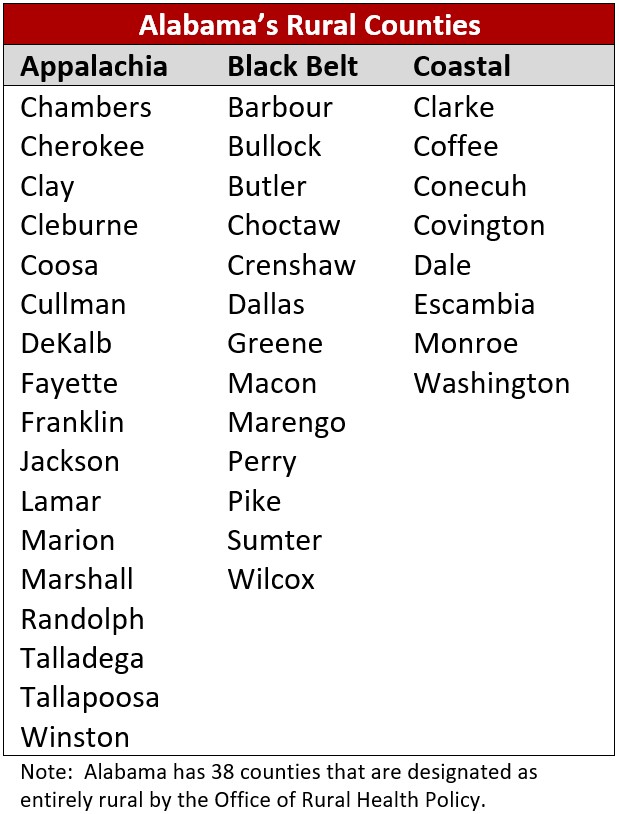
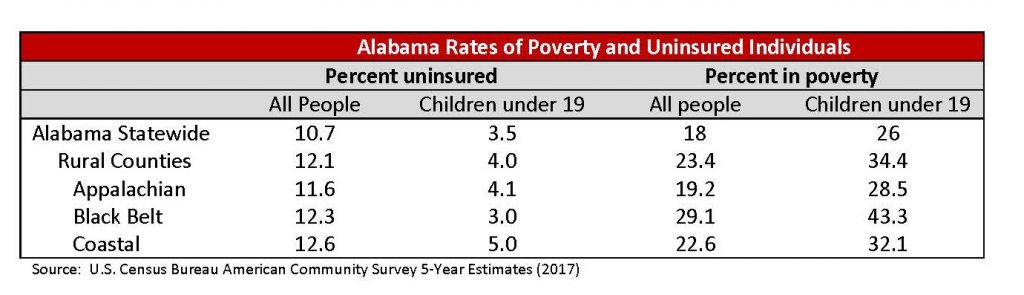
Alabama’s rural counties have a higher percentage of people who are without insurance and whose income is below the poverty level. In Alabama’s rural counties, 12.1 percent of all people are uninsured and 23.4 are in poverty.  Statewide, 10.7 percent of all people are uninsured and 18 percent are in poverty. A full and accurate count of Alabama’s population and its characteristics is essential when allocations are made to states for programs designed to provide health insurance to those who otherwise would be uninsured or unable to afford nutritious food due to poverty. For instance, in fiscal year 2016, Alabama programs received the following funding based on data gathered in the 2010 Census:

Medicaid: $3.96 billion

Medicare Part B: $1.13 billion

Children’s Health Insurance Program (CHIP): $457 million

Supplemental Nutrition Assistance Program (SNAP): $1.2 billion

Supplemental Nutrition Program for Women, Infants, and Children (WIC): $110 million  
 

Completing and returning your 2020 census form is a simple civic duty that will ensure Alabama receives its fair share of funding. In mid-March 2020, the U.S. Census Bureau will mail a packet to every Alabama home. The census can be completed online, over the phone, or by paper form. Remember—Alabama Counts!
More data on healthcare coverage and poverty in Alabama are available at: https://www.census.gov/data.html

Data (press release) provided by: Dr. Shannon Murphy, a Socioeconomic Analyst who works for the Center for Business and Economic Research (CBER) within the Culverhouse College of Business. Dr. Murphy may be reached by phone at (205) 348-9698 or by email at shannon.murphy@cba.ua.edu.

The Center for Business and Economic Research in the Culverhouse College of Business at The University of Alabama was created in 1930, and since that time has engaged in research programs to promote economic development in the state and provide economic and demographic forecasting, data, and analysis. CBER is a member of the U.S. Census Bureau Federal-State Cooperative for Population Estimates (FSCPE) and Federal-State Cooperative for Population Projections (FSCPP) programs, and houses the Alabama State Data Center (ASDC).



CBER Researcher Article Published in Population Review Journal

  • November 5th, 2019

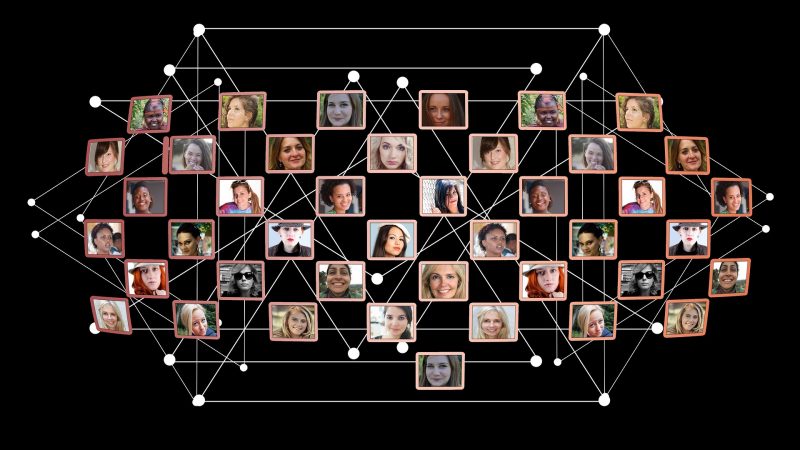
CBER researcher, Viktoria Riiman, collaborated with computer scientists from national laboratories: Peter Pirkelbauer, Amalee Wilson, and Reed Milewicz, on using artificial neural networks for population projections. Their article “Comparing Artificial Neural Network and Cohort-Component Models for Population Forecasts” was published in the “Population Review” journal recently. As the title suggests, the article compared the forecasts generated by the artificial neural network models with population projections from the traditional cohort-component method, for counties in Alabama. The authors used population projections produced by CBER in 2001. CBER is a member of the U.S. Census Bureau Federal-State Cooperative for Population Estimates (FSCPE) and for Population Projections, with FSCPE program having celebrated its 50th year in 2017.


Alabama Businesses Regain Confidence Moving into Q4 2019

  • November 5th, 2019

TUSCALOOSA, Ala. — Business leaders throughout Alabama are feeling confident moving into the fourth quarter of 2019, according to a recent report from The University of Alabama.

The Alabama Business Confidence Index, a quarterly survey of statewide business sentiment by the Center for Business and Economic Research in UA’s Culverhouse College of Commerce, showed a slight improvement in statewide business confidence, gaining 0.8 points to register at 59.3. All of the component indexes remained moderately to strongly positive, signaling Alabama business leaders’ continued expectations for economic growth in Q4 2019.

Each quarter, CBER reaches out to business leaders throughout Alabama with a simple survey about their expectations for the coming quarter. Four of the six questions gauge the panelists’ specific industry expectations, including their sales, profits, hiring, and capital expenditure, and the remaining two focus on the general economic conditions in Alabama and the US. Once CBER has analyzed the results, reports offering insight into statewide business confidence, as well as the four state’s four largest metro areas, are available on the CBER website. Alabama businesses, as well as local governments and chambers of commerce, use the ABCI to get a feel for the business community’s expectations or measure their own forecasts against.

Heading into the fourth quarter of 2019, business confidence has somewhat stabilized throughout the state’s four largest metropolitan statistical areas (MSAs) this quarter after more dramatic swings in the beginning of 2019. Like in Q3 2019, Montgomery is the only metro area that communicated negative business confidence with a mildly negative ABCI of 48.5. Meanwhile, Huntsville business leaders continue to lead in confidence with a very strong Q4 2019, while Mobile’s business community is also very confident moving into this quarter. Panelists in Birmingham-Hoover are more moderate in their expectations but are also feeling optimistic about growth compared to the previous quarter.

Looking at specific industries in Alabama, panelists in the “All Other Services” have the highest industry ABCI after increasing 1.7 points to reach 66.2 in the Q4 2019 survey. The “All Other Services” category includes management of companies and enterprises; education services; arts, entertainment, and recruitment; accommodation and food services; and other services that don’t fit into the survey’s other categories. Other industries were largely optimistic in their forecasts, with only wholesale trade forecasting a slight decrease in their industry categories this quarter.

For more details about the various industries’ responses, results broken down by firm size, and the specific levels of business confidence heading into the last quarter of 2019, you can view the ABCI reports here.