Category: Featured

Alabama business prospects looking good for the future

  • April 21st, 2021

By Kelvin Reynolds | April 19, 2021 at 9:21 PM CDT – Updated April 19 at 9:21 PM

Small Businesses Expecting Growth

BIRMINGHAM, Ala. (WBRC) – Analysts with the University of Alabama Center for Business and Economic Research surveyed people who feel very strongly about the future of Alabama’s business going into the next financial quarter.

They surveyed business leaders at the local and state level and were given feedback that now appears in Alabama’s Business Confidence Index.

It uses a scale that ranges from very good to not good. This scale gives business leaders a perspective on what the next economic quarter could look like.

They’re asked six questions about what they’re seeing in their industry and what their outlook is going forward.

University of Alabama researchers say things are looking very good.

“They’re forecasting increased sales in general, so things are looking up. I suspect, they do not have data for this, I suspect a lot of this has to do with the vaccinations= efforts and people feeling more comfortable being out and about supporting businesses,” according to Susannah Robichaux.

You can see information from the Alabama Business Confidence Index, here.

Copyright 2021 WBRC. All rights reserved.

Census Updates for MPO Planners Conference

  • April 12th, 2021

CBER analyst Susannah Robichaux was invited to address the MPO Planners Conference held by the Alabama Department of Transportation on Tuesday, April 7. Robichaux gave updates on the Office of Management and Budget’s announcement to increase the minimum population for metropolitan statistical areas, and shared reminders for municipalities to participate in the Census Bureau’s Boundary and Annexation Survey. To view a PDF of her presentation, click here.

As a reminder, CBER’s staff may make presentations at conferences and meetings for an honorarium. Feel free to reach out to individual staff members or uacber@cba.ua.edu with any speaking requests.

State Business Leaders Expecting Economic Growth

  • April 9th, 2021

TUSCALOOSA, Ala. – In the latest quarterly survey by researchers at The University of Alabama, business leaders in the state are feeling more encouraged about the economy than they have since the global pandemic began.

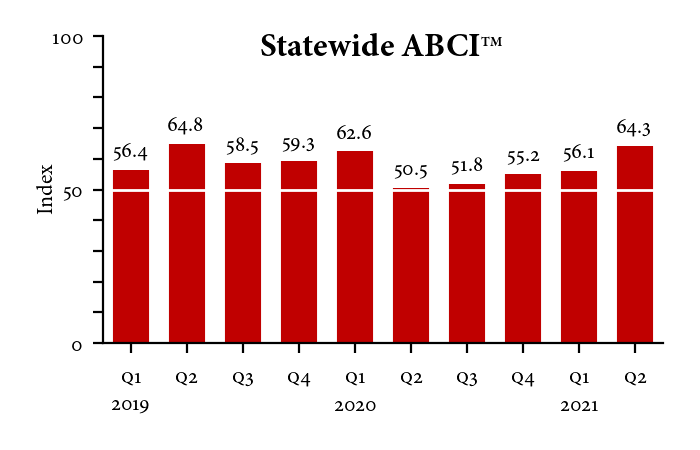
The UA Center for Business and Economic Research’s most recent Alabama Business Confidence Index shows that local business leaders have strong expectations for economic growth in the second quarter of 2021. The statewide business confidence index was 64.3, up more than eight points from the survey of the first quarter of 2021.

It’s one of the highest indexes ever and the most confident business leaders have been in the economy since the second quarter of 2019. It continues a steady recovery of confidence since the early days of the pandemic in the second quarter of 2020, when the ABCI decreased to 50.5 and business leaders were uncertain of what the coming quarter would hold for the economy.

An index over 50 indicates a positive forecast compared to the previous quarter, and the higher the number, the more confident the forecast. The statewide and national forecasts, along with industry-specific components like sales, profits, hiring and capital expenditures comprise the six indexes that combine to make the ABCI total.

“This outlook suggests that business leaders in Alabama are ‘shaking off the pandemic,’” said Susannah Robichaux, a socioeconomic analyst for the center. “When there is a higher ABCI, it signals that business leaders are feeling optimistic about the coming quarter, which is absolutely informing their own decisions about their businesses.”

Business leaders expect to see an increase in sales, profits, hiring and expenditures in the second quarter, according to the survey.

Firms of all sizes reported especially strong confidence in growth compared to last quarter, though small firms with fewer than 20 employees had the most confidence.

In a telling sign from the survey, business leaders feel strongly they will increase hiring in the second quarter compared to the first. Only 6.5% of respondents expected to decrease hiring, and the healthcare and social assistance industry is the only one of nine industry categories that expects to possibly decrease in hiring, hinting at expectations of a possible contraction after a year of industry expansion.

Overall, business leaders are more confident in the state economy than the national outlook, but confidence in both increased from the first quarter of 2021.

The breakdown of all the industry forecasts by sector can be seen in the statewide ABCI report on CBER’s website.

In addition to the statewide ABCI report, CBER also collects ABCI data to write individual reports for Alabama’s five major metro areas. These metro reports offer insight into the forecasts for each specific region.


State Business Leaders Optimistic on Early 2021 Economy

  • February 19th, 2021

TUSCALOOSA, Ala. – Even with the continued stress from the pandemic, business leaders in the state remained mostly optimistic their businesses will have a positive start to 2021, according to a quarterly survey done by economists at The University of Alabama.

The UA Center for Business Economics and Research’s most recent Alabama Business Confidence Index shows business leaders expressed sustained expectations for growth. The statewide business confidence index was 56.1, up about a point from the survey from the fourth quarter of 2020.

An index over 50 indicates a positive forecast compared to the previous quarter, and the higher the number, the more confident the forecast. The statewide and national forecasts, along with industry-specific components like sales, profits, hiring and capital expenditures comprise the six indexes that combine to make the ABCI total.

“The most important distinction is whether the index is positive, which means the majority of businesses are anticipating economic growth or negative, which means they are anticipating an economic contraction,” said Susannah Robichaux, a socioeconomic analyst for the center. “The ABCI industry components capture how business leaders are feeling about their own businesses in the upcoming quarter compared to the previous quarter, so as business leaders learn to navigate COVID restrictions, many are feeling more optimistic about their specific sales, profits and hiring.”

Interestingly, while the survey does show business leaders are overall optimistic about their businesses, their confidence in the national and state economy has decreased slightly. However, business leaders remain optimistic that both are headed in the right direction.

The small drop in economic positivity could be because the survey was taken in the first half of December, when there was more political uncertainty.

“We can’t say for certain what motivates people to answer the way they do, but I think the lower U.S. economic outlook is likely related to the political election and presidential transition of power,” Robichaux said. “Whenever there are the political transitions that appear around election time, regardless of the winning party, people tend to be less confident in their forecasts for the economic outlook.”

As for individual sectors, confidence in manufacturing increased the most, and that sector has showed the highest index at 60.7.

Business confidence in retail trade along with healthcare and social assistant services saw large decreases in their ABCIs this quarter, and business leaders are not optimistic from either sector as they and transportation, information and utilities dipped into negative outlooks for the coming quarter.

The breakdown of all the industry forecasts by sector can be seen in the statewide ABCI report on CBER’s website.

In addition to the statewide ABCI report, CBER also collects ABCI data to write individual reports for Alabama’s five major metro areas. These metro reports offer insight into the forecasts for each specific region.

Source:

Susannah Robichaux, socioeconomic analyst, UA’s Center for Business and Economic Research, 205-348-3781, scrobichaux@culverhouse.ua.edu

Contact:
Adam Jones, UA communications, 205-348-4328, adam.jones@ua.edu

The University of Alabama, the state’s oldest and largest public institution of higher education, is a student-centered research university that draws the best and brightest to an academic community committed to providing a premier undergraduate and graduate education. UA is dedicated to achieving excellence in scholarship, collaboration and intellectual engagement; providing public outreach and service to the state of Alabama and the nation; and nurturing a campus environment that fosters collegiality, respect and inclusivity.

2021 Alabama Economic Outlook

  • February 3rd, 2021

Pandemic’s Effects Will Linger on State’s Growing Economy

TUSCALOOSA, Ala. – The state’s economy could grow by 2.6% in 2021, a good clip that will not pull the state out of the hole created in 2020 by the coronavirus pandemic, according to a report published today by economists at The University of Alabama.

“It will be a couple of years before we get back to pre-pandemic level economic activity, or perhaps even longer for some sectors of the economy,” said Ahmad Ijaz, executive director of the Center for Business and Economic Research at UA. “We are in a sort of recovery mode right now, but, hopefully, we will be in expansion mode by the second half of the year.”

The 2021 Alabama Economic Outlook, available for free on the center’s website, reports the vibrations of the economic shocks from the pandemic will be felt for years, even with economic interventions from the federal government.

UA’s Center for Business and Economic Research, part of the Culverhouse College of Business, has produced forecasts of economic activity in Alabama since 1980. These forecasts cover Alabama Gross Domestic Product, employment, and income by industry group and are published in the annual Alabama Economic Outlook. Forecast updates are run quarterly. The center incorporates data from the last 30 years, including cycles and recoveries captured over the years, into its statistical and economic models.

Along with annual dives into the national and state economy, including examinations of the five largest metro areas in Alabama, this year’s outlook includes a special look at the pandemic’s effect on the state economy, authored by Dr. Nyesha Black, director of socioeconomic analysis and demographics.

In 2020, the Alabama economy contracted by 2.7%, part of a national halt to record economic growth caused by the global pandemic, according to the report. Prior to the pandemic, the state was growing at a rate that bounced from 1.5% to 2%, Ijaz said.

Alabama’s real GDP, the total value of all goods and services produced in the state, will reach about $200 billion, according the report. However, that is projected to remain below the 2019 level of about $201 billion until 2022.

Nonfarm employment in Alabama is projected to rise by 1.5 percent in 2021, reversing the 3.4 percent decline seen from Sept. 2019 to Sept. 2020, according to the outlook.

Along with continued economic issues from the pandemic, unresolved trade disputes, particularly with China, could exert downward pressure and constrain economic recovery this year, according to the report.

Sectors driving growth in Alabama’s economy in 2021 will be the financial services industry, residential construction, auto and other transportation equipment manufacturing, along with professional and business services in the scientific and technical services, waste management and administrative services.

Considering the slumping economy, state tax revenues fared well. For the fiscal year ending in September 2020, state tax receipts rose by 5.0 percent. With the expected recovery of the state economy, the center’s outlook projects tax revenues to grow by 3.8 percent this fiscal year.

Despite the recovering economy, Ijaz said more federal assistance from Congress and the Federal Reserve is needed.

“Federal intervention would definitely help, especially to some sectors of the economy that employs relatively low-skill, low-wage labor, who have primarily felt the major brunt of the recession,” he said.

The State of Microbusiness in Alabama

  • October 6th, 2020

CBER’s Director of Socioeconomic Analysis & Demographics, Dr. Nyesha C. Black, gave an update on the state of microbusinesses in Alabama at the 2020 Booker T. Washington Economic Summit on September 17, 2020. Click here to view her presentation on the state of microbusiness in Alabama.

A microbusiness is any business that has fewer than five employees. With over 49,000 microbusinesses in Alabama, according to the latest data from the U.S. Census Bureau County Business Patterns, they make up a significant part of the state’s economic backbone and workforce. Micro-establishments in the state have 90,975 paid employees, with an annual payroll of nearly $4 billion. The top sector for microbusinesses in the state is retail trade (15.0%), though there are microbusinesses in a wide variety of sectors like construction, healthcare and social assistance, and more. Though their impact on the state is significant, Dr. Black found that the proportion of microbusinesses in Alabama (49.3%) is less than the national average (54.5%).

Dr. Black also presented data from the Small Business Administration (SBA) Paycheck Protection Plan (PPP) loan database broken down by size of loan and race. In all, more than 70,000 PPP loans were allocated to Alabama’s small businesses. In addition, non-mainstream banks allocated the most loans to microbusinesses. The top five banks that allocated loans to microbusinesses were Kabbage, Inc., River Bank and Trust, Trustmark National Bank, and BancorpSouth Bank.

Examining County Unemployment during COVID-19

  • September 1st, 2020

Authored by: Nyesha C. Black, Ph.D.

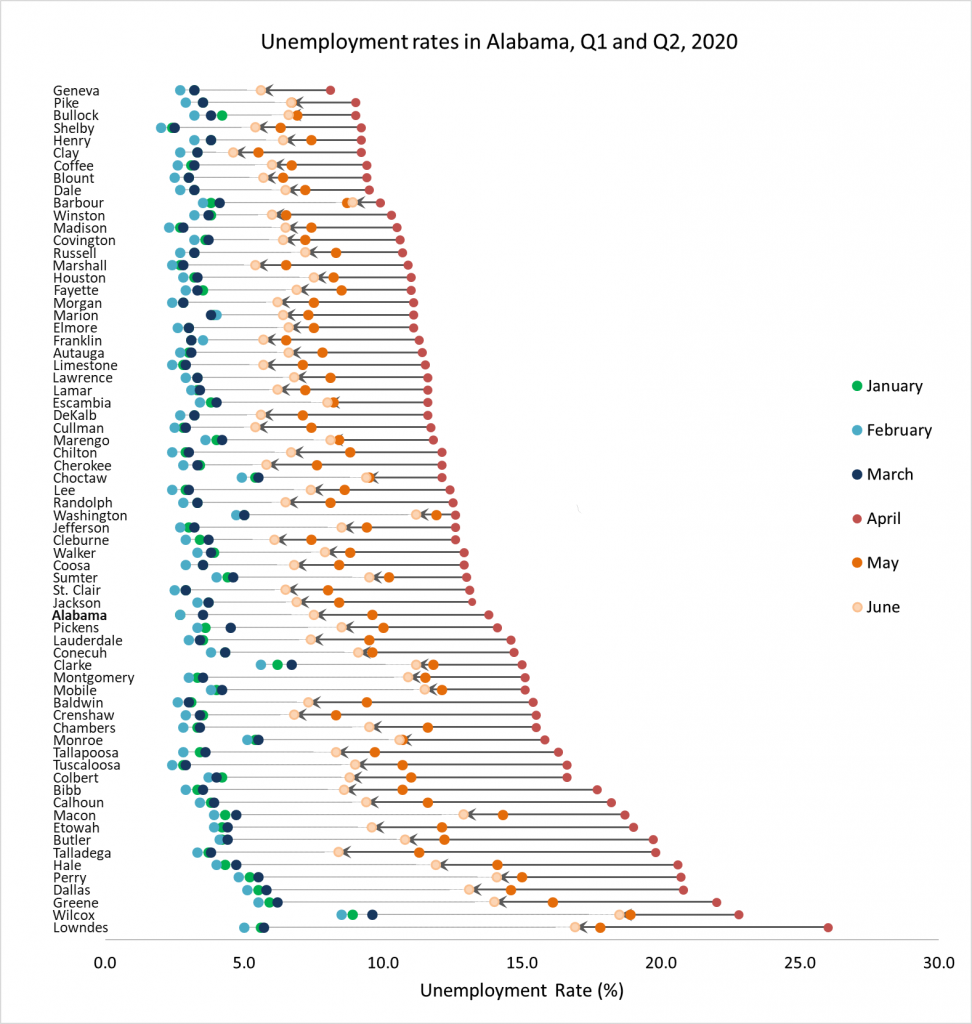
Alabama’s unemployment rate increased by nearly 300% from March to April of this year after stay-at-home orders were implemented to thwart the spread of COVID-19. While this gives us a broad-stroke view of what transpired this spring, it is worth noting that the economic shock of the pandemic affected counties differently. The dramatic variance in unemployment from Q1 to Q2 can be clearly observed in the data visualization below. The graph shows each county’s unemployment rates for January through June as color-coded dots. The unemployment rate peaked in April, among all counties, so those data points were used to sort the counties from lowest peak unemployment rate to the highest.

Scatter plot of unemployment by county for January through June of 2020
Visualization Prepared by The Center for Business and Economic Research at The University of Alabama using data from the Alabama Department of Labor and United State Bureau of Labor Statistics


Even before the pandemic, the unemployment rate varied greatly across the state. For example, the average unemployment rate during Q1 ranged from 2.3% in Shelby County to 9.0% in Wilcox County. However, by Q2, the spread was much more significant. The average unemployment rate ranged from 6.4% in Clay County to 20.2% in Lowndes County. It seems as though the differences in the counties unemployment rates were exacerbated by COVID-19. Several counties in the Black Belt already had higher unemployment rates in Q1 and experienced much higher rates in Q2 than counties with lower unemployment rates in Q1. In April, six counties, all in the Black Belt, had unemployment rates higher than 20%.

In June, unemployment rates rebounded, but the rates were still markedly higher, across all counties, compared to the end of the first quarter. By June, no county had returned to the unemployment rates in Q1, but some counties made better progress than others. For example, Clay County had unemployment rates that were the most comparable to March, but the unemployment rate for the county was still 40% higher in June. In comparison, Montgomery County unemployment rate rebounded the least among all the 67 counties, and had rates that were more than twice as high in June compared to March.

Last Push for Alabama’s 2020 Census

  • August 31st, 2020

As the lead for the Census partnership with the State of Alabama, CBER’s Alabama State Data Center is working to ensure that Alabama Counts! With high stakes on the line, including 2 congressional seats, billions of federal dollars of funding, and the importance of accurate data that will inform planning and decisions for the next 10 years, it is critical that Alabama work hard to get everyone counted before the September 30th deadline.

Alabama currently only has a 61.7% self response rate, but there’s still time to make sure your community participates in the Census. Folks can still self-respond from any computer or smart device at https://2020census.gov/ or can fill out their Census using the official 2020 response line at 884-330-2020.

Below are some links to resources for Alabama’s 2020 Census. Click the headline to read more about them.


Census Bowl has 32 counties compete for $65,000!
As the 2020 Census comes to an end on September 30th, the Alabama Department of Economic and Community Affairs and Alabama Counts! are launching one final effort to boost self-response rates: the Alabama Census Bowl. Thirty-two counties will compete in a March Madness-style bracket to see who can have the greatest increase in their self-response rates each week. The top 8 counties will receive grants for their local public school systems ranging from $20,000 to $64,000. Get involved in your community or follow along here.

In-person Census Follow-Up Response has Begun
Please let your communities know that Census workers have begun going door-to-door to count the households that have not yet responded to the 2020 Census. Census workers have been trained to follow proper health and safety guidelines, and will carry a valid ID badge with their photograph, so you can be confirm their ID. Read more about what to expect here, and share widely!

2020 Census Toolkit – Free Resources
Check out these free 2020 Census promotional materials that include hype videos with Alabama celebrities, informational posters, door hangers, graphics for social media posts, yard signs, and more! There is also specialized material tailored to different community groups and entities, so there’s something for everyone.

Paycheck Protection Program Retains 672,859 Jobs in Alabama

  • August 7th, 2020

More than 65,000 of Alabama’s Businesses reported that loans from the SBA’s Paycheck Protection Program were used to retain 672,859 jobs
Authored by: Nyesha C. Black, Ph.D.

As American businesses continue to grapple with the economic impact of COVID-19, the Coronavirus Aid, Relief, and Economic Security Act, also known as the CARES Act, has offered some much needed relief. The CARES Act was signed into legislation on March 20, 2020, and provided $2.2 trillion in economic stimulus. The stimulus initially included $350 billion to the Paycheck Protection Program (PPP), which was specifically earmarked to incentivize small businesses to keep employees on their payroll. The initial allocation was quickly disbursed, due to high demand; therefore, an additional $320 billion was allocated in late April to supplement the funds, which brought the total funding of the PPP to $670 billion.

In July, the Small Business Administration (SBA) released a database that details the loans that have been paid to businesses. To date, more than 5.1 million businesses, across the country, have been beneficiaries of the PPP. Businesses that received funding are currently eligible for loan forgiveness for selected expenses paid during the 24-week period after receiving a PPP loan. Full or partial loan forgiveness is also contingent upon maintaining the salaries and wages of full-time employees, as well as making mortgage, rent, and utility payments. The federally-backed loans also offer favorable terms such as an interest rate of 1% over a 2-5 year maturity period, with no collateral or personal guarantees.

In Alabama, 65,803 businesses have received a loan from the program, and these businesses, all together, reported that 672,859 jobs were retained from the direct cash-flow assistance. As such, the jobs retained represents more than 30% of all Alabamians employed in the labor force in the month preceding the first iteration of ‘stay at home’ orders mandated, in March, by Governor Kay Ivey. It is impossible to know how many of these businesses would have laid off their employees without the funding. However, it is highly likely that without the stimulus bill, the increase in unemployment, from 3.0% in March to 13.8% in April, would have been unfathomably more dramatic and devastating to Alabama’s labor force.

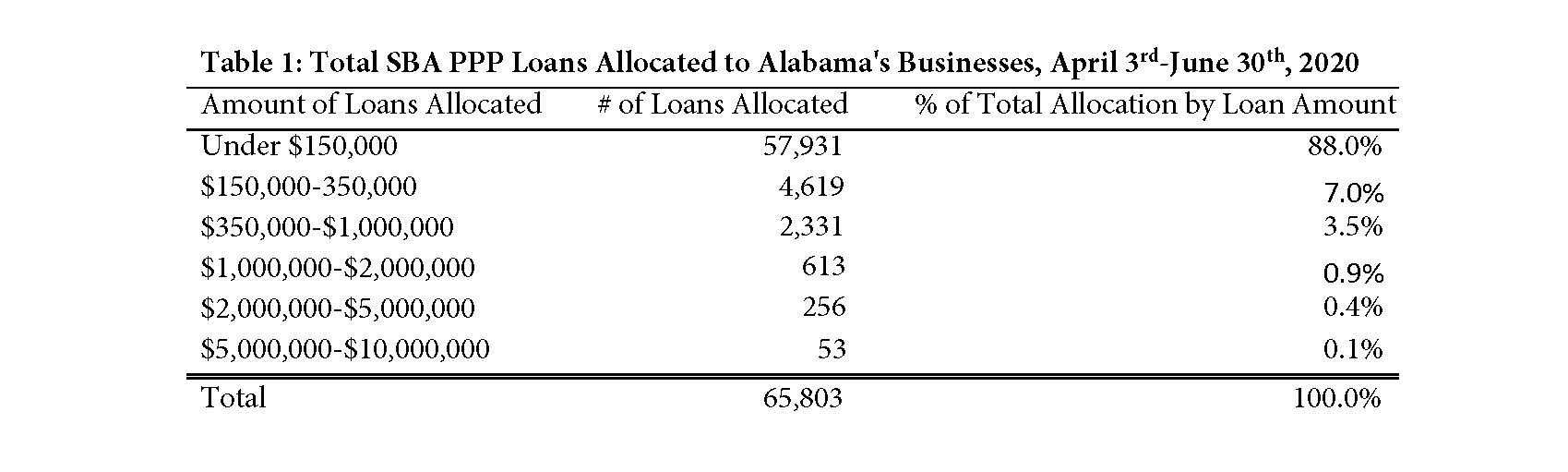
Among the businesses that received a loan, approximately 88% were paid less than $150,000. It is difficult to ascertain, from the data reported in SBA’s database, the exact sum of money distributed to businesses in Alabama. This is, in part, because businesses that received $150,000 or more in loans are collapsed into broad categories with wide monetary ranges (see Table 1). It is clear, however, that more than $1.8 billion was loaned to businesses that received less than $150,000. Nevertheless, the estimated total amount of all loans ranges from approximately $4.7 billion to $8.8 billion. In Alabama, local and regionally based banks processed most of the PPP loans. Regions Bank, headquartered in Birmingham, AL, processed 10% of all PPP loans allocated to businesses in the state. Almost a quarter of all loans distributed to businesses in Alabama were processed by only five banks – Regions Bank, ServisFirst Bank, Synovus Bank, BBVA USA, and Trustmark National Bank.
PPP TableOverall, the loans were not limited to one industry according to the NAICS¹ codes reported on loan applications. A large proportion (57.2%) of all loans allocated to businesses in Alabama were distributed to five broadly-defined industries: other services² (13.0%); retail trade (12.0%); professional, scientific, and technical services (12.0%); health care and social assistance (10.4%); and construction (9.8%). However, there is heterogeneity within each industry classification, and a further disaggregation of the data shows that almost 15% of all loans went to five specifically-defined industries: full-service restaurants (2,158); law offices (2,016); doctor offices (1,956); religious organizations (1,874); and real estate agencies (1,769). The loans were not limited to for-profit business, as almost 5% of PPP loans were allocated to non-profits in the state. In addition, more than a majority (57.6%) of jobs retained from PPP funding were in only five of the following broadly-defined industries: health care and social assistance (14.1%); accommodation and food services (12.1%); retail trade (11.1%); manufacturing (10.4%); and construction (9.9%).

In sum, the blunt economic shock of the pandemic is unprecedented; as such, the unemployment rate in Alabama nearly quadrupled within a month. The data released by the SBA offers a revealing portrait of the scope and scale of businesses that were able to secure PPP funding, for cash-flow and payroll assistance, to protect jobs that may have otherwise been added to the unemployment ledger. Looking forward, uncertainty abounds on whether businesses will lay off employees, and at what scale, once the 24-week time elapses. However, it’s clear that jobs retained by the PPP provisions in the CARES Act provided a buffer from more immediate and more severe job loss, in Alabama, and throughout the country.

¹ NAICS stands for North American Industry Classification System. The systems in standardly used by federal agencies for classifying business establishments for the purpose of collecting, analyzing, and publishing statistical data related to the U.S. business economy.
² Other services (81) includes all services that are not provided in other NAICS classification system. Other services include businesses primarily engaged in machinery repairing, promoting or administering religious activities, grantmaking, advocacy, and providing dry cleaning and laundry services, personal care services, death care services, pet care services, photofinishing services, temporary parking services, and dating services.

How the COVID-19 Pandemic is Affecting Food Insecurity in Alabama Households with Children

  • June 30th, 2020

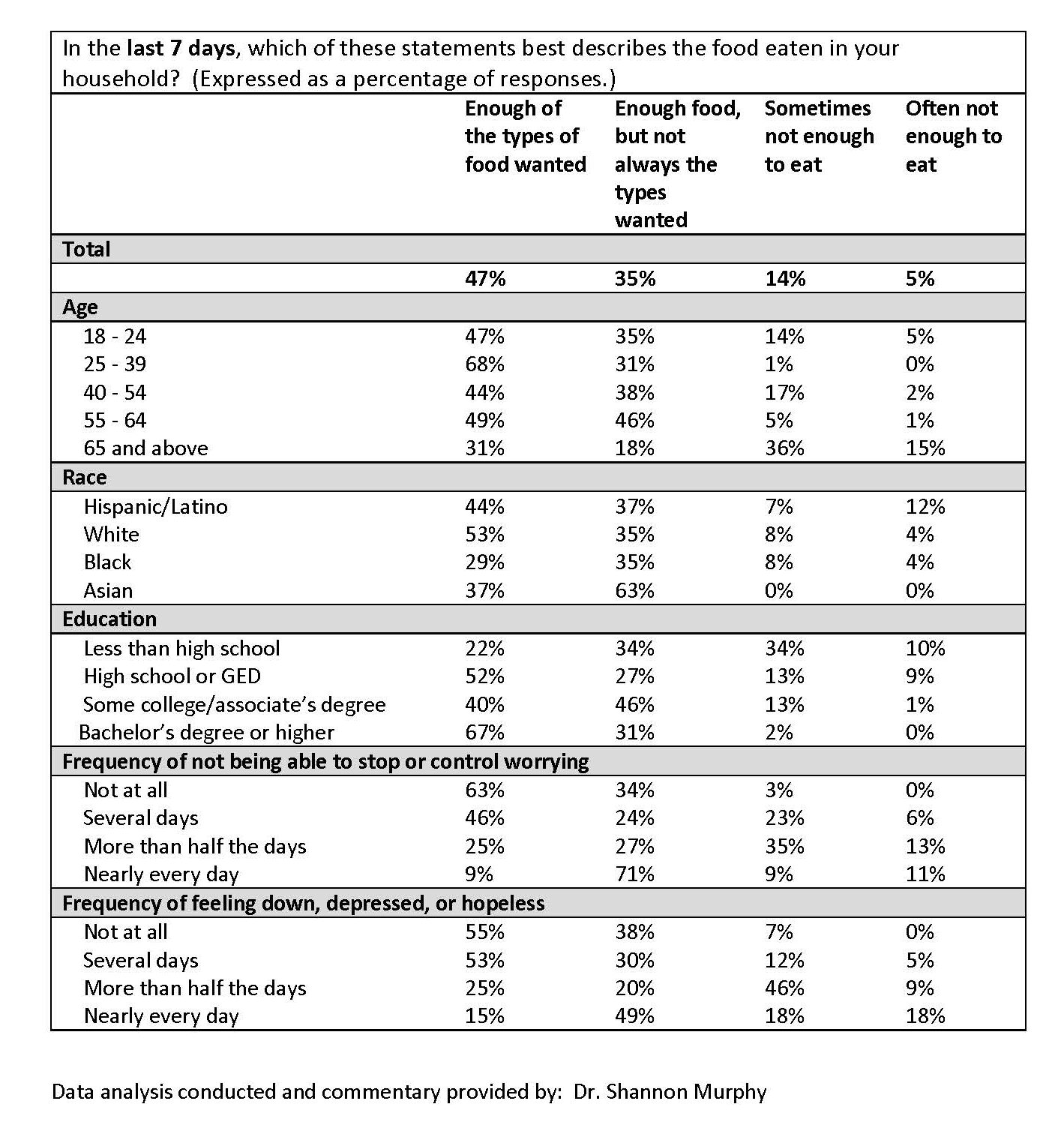
In response to the unprecedented circumstances presented by the COVID-19 pandemic, the U.S. Census Bureau has launched a new survey to meet the urgent need for timely data measuring how the pandemic is impacting households from a social and economic perspective. The Household Pulse Survey includes questions on how jobs, finances, access to food, health, housing, and education have been affected by the pandemic. The analysis below focuses on how the pandemic is affecting food insecurity (a measure of whether or not the people in the home have enough to eat in the last seven days) in Alabama households with children based on the latest published survey data covering the week of June 11-16. 

Overall, the news is good in that most (82%) Alabama homes with children report having enough food in the last seven days, if not the types they wanted. However, when respondents are broken down into demographic groups, patterns emerge where the elderly, people of color, and people with low levels of educational attainment are suffering from food insecurity and an associated strain upon their mental health. 

Fifteen percent of respondents aged 65 or older with children in the home report often not having enough to eat in the last seven days, compared to 5% of 18-24 year-olds, 0% of 25-39 year-olds, 2% of 40-54 year-olds, and 1% of 55-64 year-olds. (Note that while it may seem odd that a respondent aged 65+ would have children in the home, in 2018 the Annie E. Casey Foundation reported 7% of Alabama’s children lived in the care of their grandparents.) Another pattern emerges when race is considered, as 12% of Hispanic households with children report often not having enough to eat in the last seven days, compared to 4% of White and Black households and 0% of Asian households. Education is also a factor in that only 22% of respondents with less than a high school education report that their household has had enough of the types of food they wanted. Meanwhile, the percentage of respondents saying their household did have enough of the types of food they wanted was much higher for respondents with a high school diploma/GED (52%), some college or an Associate’s degree (40%), or who held a Bachelor’s degree or higher (67%). 

The Household Pulse Survey data also indicates the stress of food insecurity is having a negative impact upon respondents’ mental health. Those who have sometimes or often not had enough to eat in the last seven days report higher frequencies of symptoms related to anxiety or depression. For those who say they have sometimes not had enough to eat in the last seven days, 35% report feeling unable to stop or control worrying at least half the days and 46% of them report feeling down, depressed, or hopeless at least half of the days. For those who say they often have not had enough to eat in the last seven days, 11% say they are unable to stop or control worrying nearly every day and 18% report feeling down, depressed or hopeless nearly every day. 

Food insecurity is just one way the COVID-19 pandemic is having an effect upon Alabama households. For more information, the full Household Pulse Survey data (to include data for each state and the U.S. as a whole) may be found at the U.S. Census Bureau’s website: https://www.census.gov/data/tables/2020/demo/hhp/hhp7.html